
 Tiếng Việt
 简体中文
简体中文 Deutsch
 日本語
日本語 한국어
한국어 ไทย
ไทย Русский
 Français

Chọn hệ Solar & lưu trữ cho công trình
Từ nhu cầu sử dụng điện đến cấu hình và dự toán sơ bộ. Không cần thông tin liên hệ.
Cụm tính toán tự động trước khảo sát
Kết quả hiện ở đây khi nhập đủ dữ liệu: diện tích pin, phần phụ trợ, mái cần dùng, tải module, công suất và cấu hình điện.
Phát triển và vận hành bởi QuangAnhcons. Kết quả sơ bộ cần khảo sát và xác nhận bằng văn bản trước khi đặt hàng hoặc thi công.
Solar 8.19.0 · QAC-UI-QUOTE 1.1.0
© 2026 CÔNG TY TNHH XÂY LẮP ĐIỆN QUANG ANH. Báo giá được lập bởi QuangAnhcons. Vui lòng giữ nguyên tên đơn vị lập và số tham chiếu khi lưu hoặc chia sẻ. Tên và tài liệu của bên thứ ba thuộc chủ sở hữu tương ứng.
The decision to select a transformer for a rooftop solar system rated at 9700 kWp requires a clear separation between DC capacity (kWp) and the AC power at the grid connection point. This blueprint provides the calculation framework, the mandatory site data checklist, a sample worked example with transparent assumptions, and comparison criteria for transformer options so the engineering team can proceed to detailed design or RFQ. [1]
Transformer selection must be based on the total actual AC power at the point of interconnection (typically the summed nameplate AC capacity of the inverters or the PCC export limit), the connection voltage and grid requirements — you should not use the 9700 kWp DC value alone.
Perform sizing calculations with explicit assumptions (total AC kW, coincidence/peak factors, safety margins) and then decide: one large transformer or multiple smaller units, short-circuit characteristics, and appropriate cooling/tap-changer options.
A site survey (fault level, voltage, cable routes, on-site UPS/loads) and checking the grid operator’s interconnection conditions (EVN) are mandatory prior to finalizing specifications and procurement.
Who is this for?
- Plant electrical/technical teams and EPC project managers
- PV system design consultants / grid interconnection engineers
- Procurement decision-makers who need specifications to request quotes
When to read this?
- When preparing inverter-to-transformer connection design for a 9700 kWp rooftop project
- Before issuing RFQs or finalizing the bill of materials (tender/RFQ)
- When evaluating one large transformer versus multiple smaller transformers
Overview: objectives and concepts to distinguish
Differentiating kWp (DC) and AC power at the point of interconnection; the objective of sizing the transformer for a 9700 kWp rooftop installation and the main technical decisions involved.

kWp is the solar peak power rating measured on the DC side, while the AC power at the grid connection is the actual output through the inverters and delivered to the transformer; therefore transformer sizing must be based on the AC power at the connection point, not only on module kWp. [3][13]
From a site perspective, check the total AC rated power on the inverters, the inverter clipping behaviour and the plant’s export control strategy; typically the DC input (kWp) is larger than the nameplate AC, and the conversion depends on derating factors, inverter efficiency and operating conditions.
When setting the transformer sizing objective for a 9700 kWp rooftop system, clearly state the goal: to serve the maximum AC power possibly exported to the grid, or to size for expected operational average power with a contractual export limit at the PCC; each objective leads to different transformer ratings and protection schemes.
| Decision criteria | Notes / site checks |
|---|---|
| Total AC capacity of the inverters | Read inverter nameplates, verify operation mode and export limits |
| DC characteristics (kWp) and DC/AC ratio | Compare total kWp with total AC, assess clipping risk during peak hours |
| Connection voltage and grid arrangement | Survey required to determine point-of-connection voltage and grid interconnection conditions per EVN |
| Short-circuit level and switching capability | Determine on-site fault level to select transformer type and protection equipment |
| Operational objective (export limit or no-export) | Directly impacts design and inverter control strategy |
Two practical operational warnings: first, do not size transformers solely on module kWp because you risk oversizing or undersizing if inverter clipping and export limits are not accounted for; second, survey short-circuit levels and the actual connection arrangement at site because these parameters determine transformer type, insulation class and protection requirements.
Conclusion: after distinguishing kWp and AC power at the point of interconnection and defining the sizing objective for the 9700 kWp system, the next step is a detailed site survey (connection voltage, total inverter AC, short-circuit level, EVN requirements) to proceed with calculations and select the appropriate transformer.
To finalize transformer specifications for a 9700 kWp system you need: (1) collect full site data and total AC capacity; (2) run sizing calculations using a worked example with explicit assumptions; (3) compare options and confirm grid interconnection conditions with EVN before ordering. The next step is to perform a site survey and a detailed worked example calculation.
Frequently Asked Questions
Can I use the 9700 kWp (DC) figure directly to choose transformer rating?
No. Do not use the 9700 kWp DC value directly to select a transformer. Rule: sizing should be based on AC power at the point of interconnection (total kW of the inverters or PCC limit) plus peak/safety factors. Required additional data: total AC capacity, DC/AC ratio, connection voltage, export limits and short-circuit level.
Should I choose one large transformer or multiple smaller transformers for a 9700 kWp rooftop?
Choosing one large transformer or multiple smaller units depends on priorities: a single large transformer often reduces cost but gives less redundancy; multiple transformers increase redundancy and simplify maintenance but require more space and higher initial cost. Required data: budget, connection scheme, installation space, redundancy requirements and short-circuit level.
What site parameters are mandatory to complete transformer sizing calculations?
Mandatory: total AC capacity of all inverters (kW), connection voltage (MV/LV), PCC export limit, short-circuit level at the connection point, connection arrangement, ambient temperature/altitude, cable distances and on-site self-consumption. If any are missing, state assumptions clearly and collect the missing site data.
How to handle over-peak situations when the PV system reaches maximum output?
Handle by AC output control: configure inverter power limiting/curtailment, set an export limit at the PCC, or design the transformer capacity/control to accept clipping. Required data: grid export limits, curtailment policy and inverter characteristics to choose the control option or increase capacity accordingly.
Steps to select the transformer for a 9700 kWp rooftop system
- Step 1 — Collect data: total AC capacity of all inverters (kW AC), connection voltage (MV/LV), connection arrangement, PCC export limit, short-circuit level at the connection point, ambient temperature, cable distances and on-site consumption (self-consumption).
- Step 2 — Conversion and assumptions: convert 9700 kWp DC to expected AC output (based on the inverter DC/AC ratio or manufacturer data); determine peak/coincidence factors (e.g., PV oversizing, power factor) and safety factors for sizing.
- Step 3 — Preliminary transformer rating calculation (kVA/MVA): use total AC power as the basis, apply appropriate coincidence/peak factors and choose the voltage level, then determine the transformer’s rated capacity; if data is missing, list scenario assumptions for comparison.
- Step 4 — Check electrical characteristics: determine suitable %impedance/internal reactance of the transformer according to short-circuit requirements, select tap-changer, cooling arrangement and preliminary protection scheme.
- Step 5 — Evaluate options (1 transformer vs multiple units): compare cost, operation, redundancy, maintainability and grid-connection criteria.
- Step 6 — Site survey & confirm regulations: verify actual short-circuit level, installation conditions, EVN/MOIT requirements and finalize technical dossier for procurement.
- Step 7 — Commissioning and testing: prepare post-installation test program (measurements, insulation test, ratio/phase check, functional test) and verify compatibility with inverters/instrumentation.
If required, QuangAnhcons can support site surveys and detailed calculations to turn the plan into technical specifications and RFQs.
References (18)
Use authoritative real sources (EVN/Ministry of Industry and Trade regulations, TCVN/IEC/IEEE standards where applicable). Any technical recommendations or calculation values must include links to source documents for traceability; when a source is missing or its validity is uncertain, the content will state the uncertainty and the assumptions used.
-
tcvn.gov.vn
Official source from tcvn.gov.vn used to verify technical information or referenced regulations.
-
National standard publication decision
Official source from tcvn.gov.vn used to verify technical information or referenced regulations.
-
EVN advisory to MOIT on rooftop vs ground-mounted PV interconnection issues
Standard/regulatory document used to cross-check technical requirements mentioned in the article.
-
EVN advisory to MOIT on rooftop vs ground-mounted PV interconnection issues
Official source from evn.com.vn used to verify technical information or referenced regulations.
-
National standards system in the solar power field
Official source from tcvn.gov.vn used to verify technical information or referenced regulations.
-
Site diagram
Official source from tcvn.gov.vn used to verify technical information or referenced regulations.
-
MOIT guidance on rooftop solar development
Official source from evn.com.vn used to verify technical information or referenced regulations.
-
MOIT circular amending electricity operation management
Official source from moit.gov.vn used to verify technical information or referenced regulations.
-
cskh.evnhcmc.vn
Official source from cskh.evnhcmc.vn used to verify technical information or referenced regulations.
-
Draft circulars amending several MOIT circulars
Official source from moit.gov.vn used to verify technical information or referenced regulations.
-
EVN HCMC: summary of upgrading distribution from 15kV to 22kV
Official source from evn.com.vn used to verify technical information or referenced regulations.
-
EVNHCMC promotes solutions to accelerate rooftop solar
Official source from evn.com.vn used to verify technical information or referenced regulations.
-
EVNHCMC guidance
Official source from cskh.evnhcmc.vn used to verify technical information or referenced regulations.
-
Reasons EVN proposes rooftop solar self-use registration
Official source from evn.com.vn used to verify technical information or referenced regulations.
-
Reasons EVN proposes rooftop solar self-use registration
Official source from evn.com.vn used to verify technical information or referenced regulations.
-
Decree on renewable energy development
Official source used to verify technical references.
-
Decree document
Official source used to verify technical references.
-
EVN continues advisory on rooftop PV challenges
Official source used to verify technical references.
Substation budget estimate
Select the capacity, route lengths and package to view your indicative budget and electrical parameters.
Request a project quotation
Send your project details, BOQ or drawings to request a formal quotation. Fields marked * are required.
Quotation scope
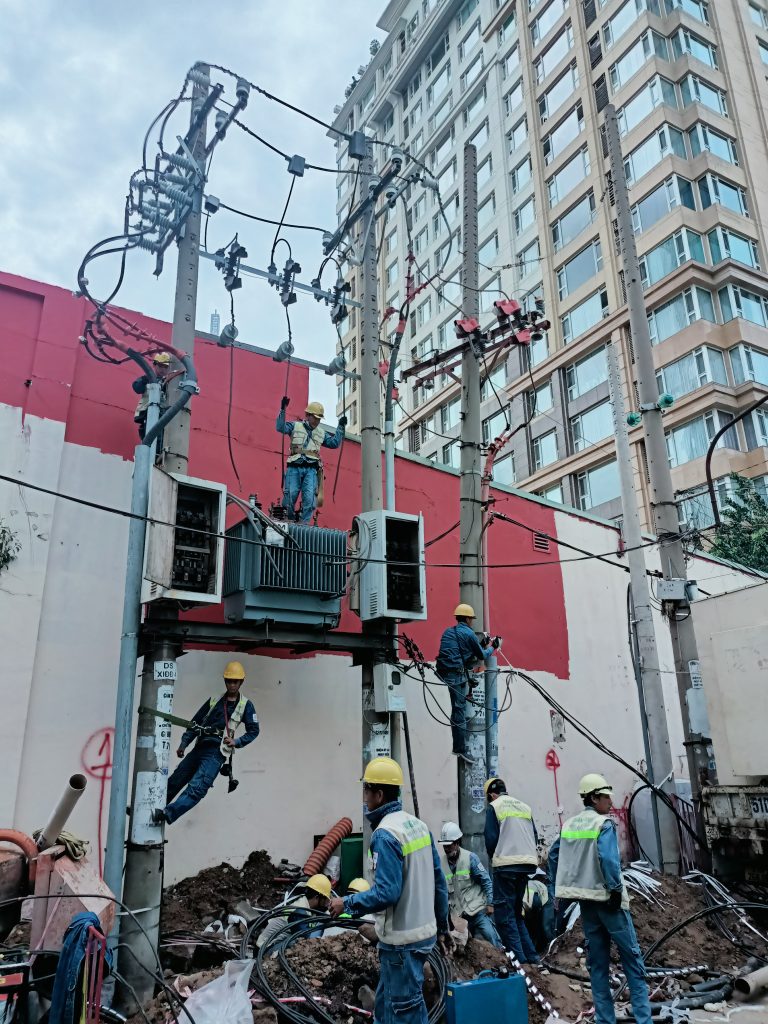
Applies to one EVN-supplied substation with oil-immersed transformers at 22/0.4 kV (single-phase: 12.7/0.23 kV), with MV metering VTs/CTs supplied by EVN. The estimate includes the selected equipment, installation, earthing, transformer-to-main-breaker connections, design and connection documentation, and coordination of testing and utility acceptance.
Kiosk, integrated steel-pole and indoor substations include MV switchgear and the entered underground cable route. Other outdoor arrangements use the relevant protection configuration. The final diagram must meet the project connection requirements.
Excludes VAT, cables from the substation switchboard to the MSB/loads, live-line work, harmonic reactors, weak-ground treatment or special piling, land and special fire-protection provisions. Underground routes assume normal construction conditions and exclude road drilling and special reinstatement.
Prices are indicative investment budgets. A formal quotation follows site assessment and agreement on the configuration. Electrical selections are preliminary and require design verification before installation.
Capacity range and application conditions
The catalogue defines the enquiry range of this tool, not universal TCVN capacity limits. Single pole-mounted transformers: 15–100 kVA; three-unit banks: 3×15–3×100 kVA. Platform substations: 100–630 kVA. Steel-pole substations: 100–630 kVA; 750/800 kVA require design verification and local approval. Ground-mounted, kiosk and indoor configurations: 50–10,000 kVA. Not every configuration has a package price or the same structural design.
Reference: EVN Decision 1299/QD-EVN dated 3 November 2017, Volume 1, sections 3.3–3.4. Check the current requirements of the responsible utility before implementation. Kiosks must meet manufacturer ratings and testing requirements (IEC 62271-202); indoor and ground-mounted arrangements must meet project layout, ventilation, structural and fire-protection requirements. For multiple transformers, specify the quantity and capacity of each unit.
Developed by QuangAnhcons · © 2026 QuangAnhcons. Code licensed under GPL-2.0-or-later. Standards and manufacturer data belong to their respective owners.