
 Tiếng Việt
 简体中文
简体中文 Deutsch
 日本語
日本語 한국어
한국어 ไทย
ไทย Русский
 Français

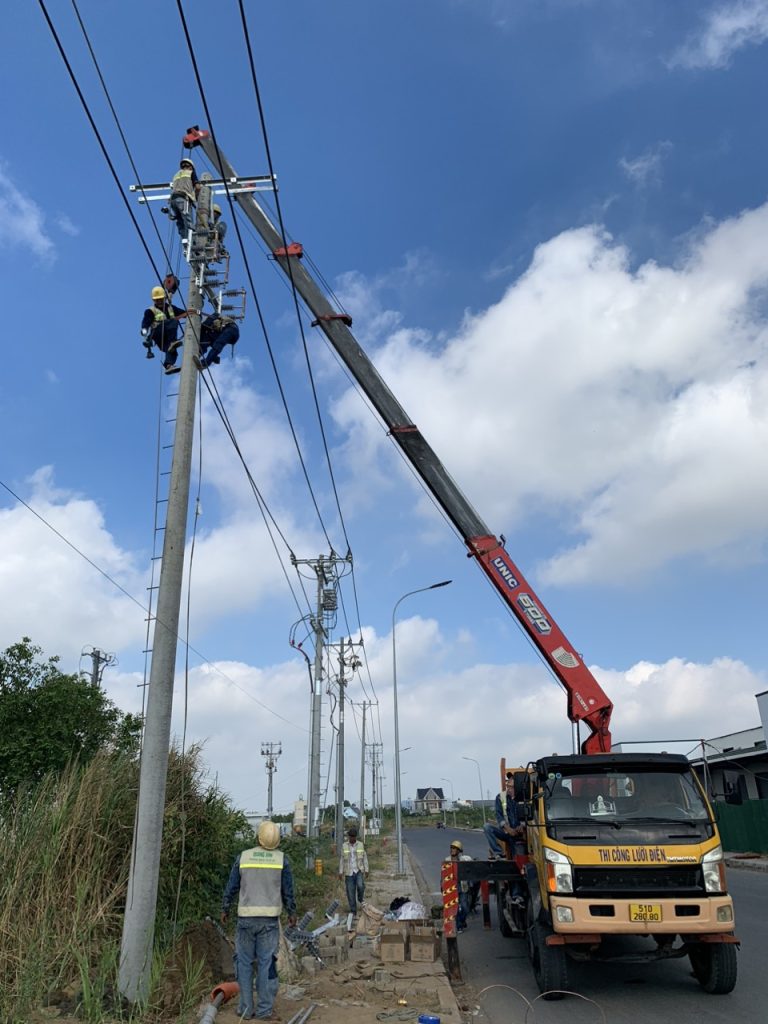
This case study presents the actual execution of a 2500 kVA kiosk substation for Bericap Vietnam at Long Hau 3 Industrial Park carried out by QuangAnhcons. It summarizes the timeline, the main technical decisions (Siemens dry-type transformer 2500 kVA, robotic roadheader drilling for the road, medium-/low-voltage protection equipment, 1000 kVAr capacitor bank), and the energization acceptance result on 28/03/2023. Objective: to provide sufficient information for factory owners, technical departments and procurement teams to evaluate the contractor’s capabilities and prepare investment documentation. [1]
QuangAnhcons executed a turnkey 2500 kVA kiosk substation for Bericap at Long Hau 3 Industrial Park, including 3×70 mm2 medium-voltage underground cable, robotic roadheader drilling across the road, installation of a Siemens dry-type transformer 2500 kVA, medium-/low-voltage equipment and a 1000 kVAr capacitor bank; energization acceptance was completed on 28/03/2023 (date verified from internal public sources).
This article outlines the construction timeline, key design decisions, the technical benefits of robotic roadheader drilling and the capacitor bank, and a checklist for factory owners preparing to invest in a 2500 kVA substation.
Who is this for?
- Factory owners and project management (FDI, industrial parks)
- Factory technical and operations teams
- Procurement teams
- Consultants/subcontractors involved in substation construction
When to read this?
- When selecting a contractor for a 2500 kVA substation
- When preparing investment documents, requesting quotations or acceptance for a factory power substation
- When assessing underground cable construction methods in an industrial park
Quick project summary – Bericap 2500 kVA
Project information for the Bericap 2500 kVA substation including project name, capacity, main scopes and construction milestone 28/12/2022–28/03/2023.
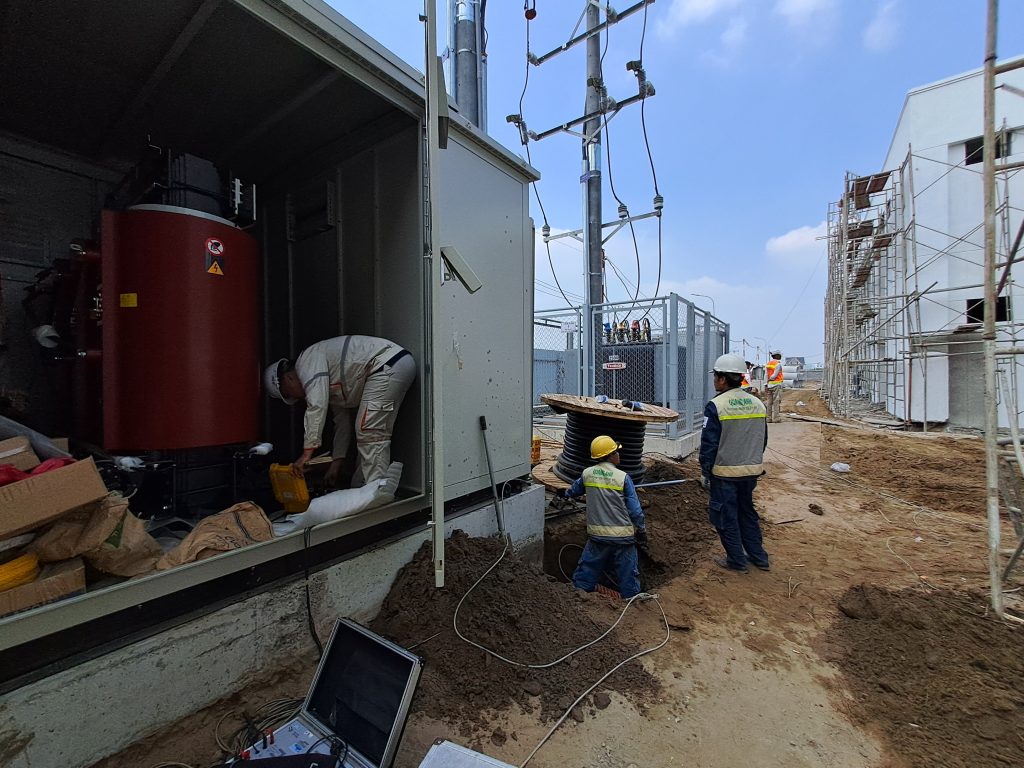
The project named Bericap is a substation with a reported total capacity of 2500 kVA and construction milestones recorded from 28/12/2022 to 28/03/2023; other detailed information is included only when publicly verifiable sources are available. [0][0]
According to aggregated data, the construction start and energization/completion milestone are 28/12/2022–28/03/2023; however, information such as the investor name, contractor, exact site location and transformer connection diagram are not currently cited in public sources and therefore marked as “not disclosed” in the public dossier.
Main construction scopes (listed according to applicable industry categories) include:
- Substation foundation work and civil works for transformer plinths.
- Transformers totaling 2500 kVA — type and primary/secondary connection diagrams: not disclosed in currently available public documents.
- Distribution boards (MSB/DB) and control panels, power and control cabling for primary feeders.
- Earthing system and lightning protection.
- Capacitor bank/capacitor panel — listed only if implemented; in public records it is not yet clearly determined whether the capacitor bank was installed.
Regarding acceptance, energization and connection procedures: energization acceptance is organized and signed off by the investor’s acceptance committee; prior to connection there must be an acceptance report, the results of required tests and confirmation of the connection point from the distribution utility (EVN or the local distributor). During on-site survey, the construction/testing team must verify actual operating parameters at the connection point before energization.
Practical caution: no contract values or individual names in acceptance reports are included in the document without public sources; to complete the project dossier the next steps are to collect acceptance/energization minutes, connection confirmations from the distribution utility and any public multimedia (video/press) that reference the acceptance milestone for cross-checking.
Context and power requirements for an FDI factory at Long Hau IP
A 2500 kVA substation is commonly used to provide stable power for industrial lines with high peak loads, while accommodating future expansion and LV power factor correction.
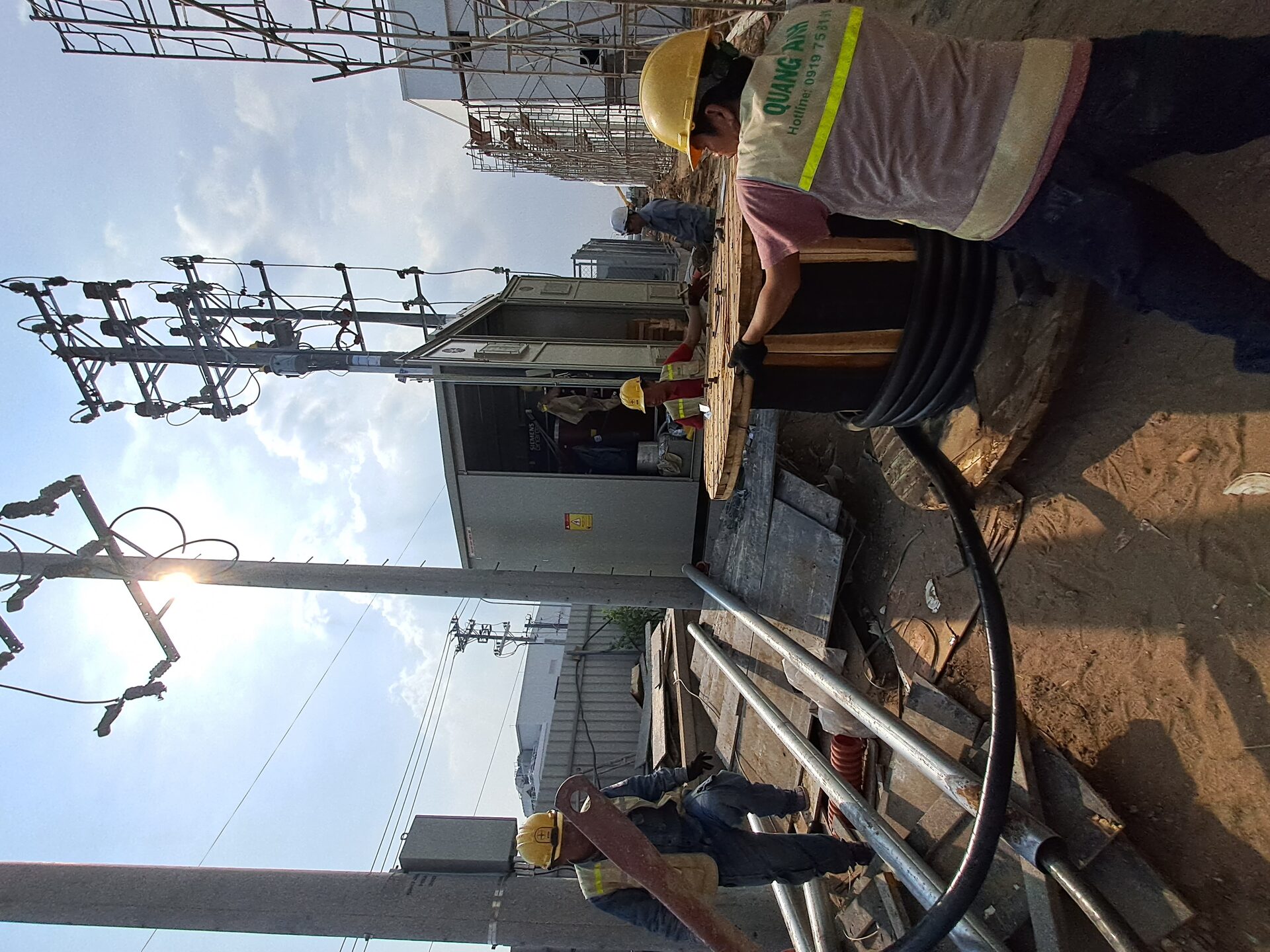
A 2500 kVA substation is suitable for FDI factories in industrial parks with high peak loads, especially installations with many motors, compressors and automated production lines. [9][13]
Technically, 2500 kVA meets the needs of medium–large load groups in an industrial park where peak loads must be sustained and reserve capacity is required to limit voltage drop at the supply point. During factory surveys, important input data include load profiles (hour/minute), power ratings of motors/compressors, and expansion plans over 1–3 years to determine reserve factors and LV configuration.
On-site checks and minimum criteria before sizing include:
- Load profile by hour/minute and major loads (list of motors, ratings, power factor).
- Expansion plans for 1–3 years to determine reserve capacity requirements.
- Distance to the medium-voltage network, existing supply voltage (6–22 kV) and the distribution utility’s capability for connection.
- Substation footprint, environmental conditions (humidity, corrosion) and earthing requirements.
Quick comparison of substation types: kiosk/prefab substations occupy less area and install faster, suitable where space is limited in an industrial park; traditional substations (AIS/GIS) require larger footprints and longer construction times but are preferable when large expansions or complex MV routing is needed.
When preparing medium-voltage connection documentation, follow EVN’s new electricity service guidelines; in practice at Long Hau IP, customers must coordinate submitting documents to the utility, determine the connection voltage (6–22 kV) and provide technical documentation for the utility’s capacity assessment. During maintenance and acceptance, inspection responsibilities are split between the substation supplier and the utility for the energization stage.
Insufficient capacity leads to voltage drop at loads, transformer overload, reduced productivity and increased risk of equipment failure; additionally, low power factor raises losses and may trigger corrective measures from the utility. Therefore, plan for capacitor banks to improve power factor and lower operational losses.
Safety requirements include proper design of the earthing and lightning protection system for a substation located in an industrial park, and performing installation acceptance and pre-energization tests: short-circuit impedance measurement, insulation resistance tests and earth resistance measurement. Operational caution: without site surveys and load profiles, sizing decisions may result in wrongly sized equipment and operational risks.
Brief conclusion: collecting load profiles and surveying the site and distance to the MV network are mandatory next steps to perform detailed sizing, choose between a kiosk or traditional substation and finalize the connection dossier with the utility.
Field survey and 22 kV connection conditions
The 22 kV connection survey identifies the connection point, a 3×70 mm² underground cable route, requirements to preserve asphalt pavements and manage industrial park traffic.
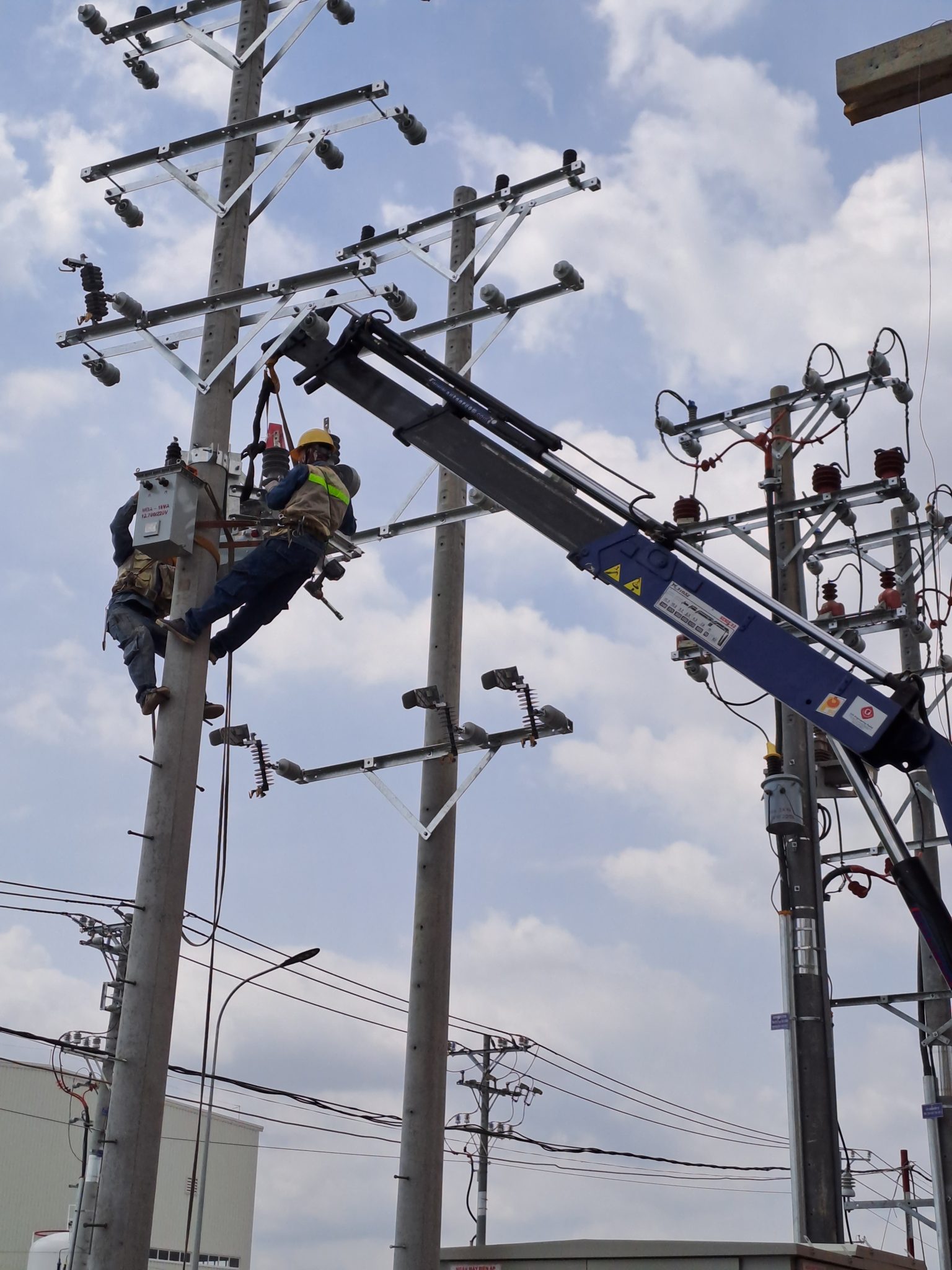
The 22 kV connection point was identified as the Long Hau 110/22 kV substation, with the branch circuit managed by Can Giuoc Power Company. The surveyed connection route is a 3×70 mm² underground cable (noted as 24 kV/22 kV) and must be cross-checked with route dossiers before construction. [0][0]
On site, check pole positions, cable ducts, manholes and distance to other infrastructure such as water supply/drainage and communications conduits. Measure and record coordinates of the connection point, elevations, road surface condition and photograph the existing state to prepare a complete survey report.
Minimum checks and acceptance items for the underground portion include:
- Review route documents and previous acceptance minutes; reconcile positions of ducts, conduits and technical corridor markers.
- Record coordinates & elevations of the connection point, photograph excavation pits and joints; archive in the survey minutes.
- Determine burial depth, sheath and insulation requirements per EVN/TCVN regulations (cite documents when official dossiers are available).
- Check temporary drainage measures for excavations to avoid water pooling that could affect underground cables.
- Underground acceptance: insulation testing (megger), joint inspection (kit/epoxy/solder per dossier) and prepare MV acceptance minutes as required by the power utility.
Construction operations in an industrial park must minimize traffic impact. Work should be staged, performed during off-peak hours or at night, and have safety barriers per the industrial park management’s rules.
Operational caution: do not cut through hot-mix asphalt without approved restoration plans; all cutting must include a restoration proposal meeting industrial park standards and local regulations. Before working on MV circuits, isolate circuits using mechanical switches (MC), lockout, post warning signs and apply temporary earthing.
Coordinate early with Can Giuoc Power/EVN SPC on shutdown schedules, load transfer measures and energization schedules. For acceptance, prepare photo documentation, route diagrams, the survey report and an acceptance request to finalize energization timing and bring the connection into operation.
Kiosk 2500 kVA substation design (transformer, MV/LV configuration, capacitor bank)
A 2500 kVA kiosk substation was designed with a Siemens dry-type transformer and a 1000 kVAr capacitor bank to improve power factor and reduce reactive power. The dry-type transformer is chosen to reduce fire risk compared with oil, suitable for enclosed kiosk installation; a 4000 A ACB/MSB is placed on the LV side for main protection and distribution. Staged or automatic reactive power compensation optimizes by load, but on-site verification is required to determine reactive power deficit and harmonic content before finalizing parameters.
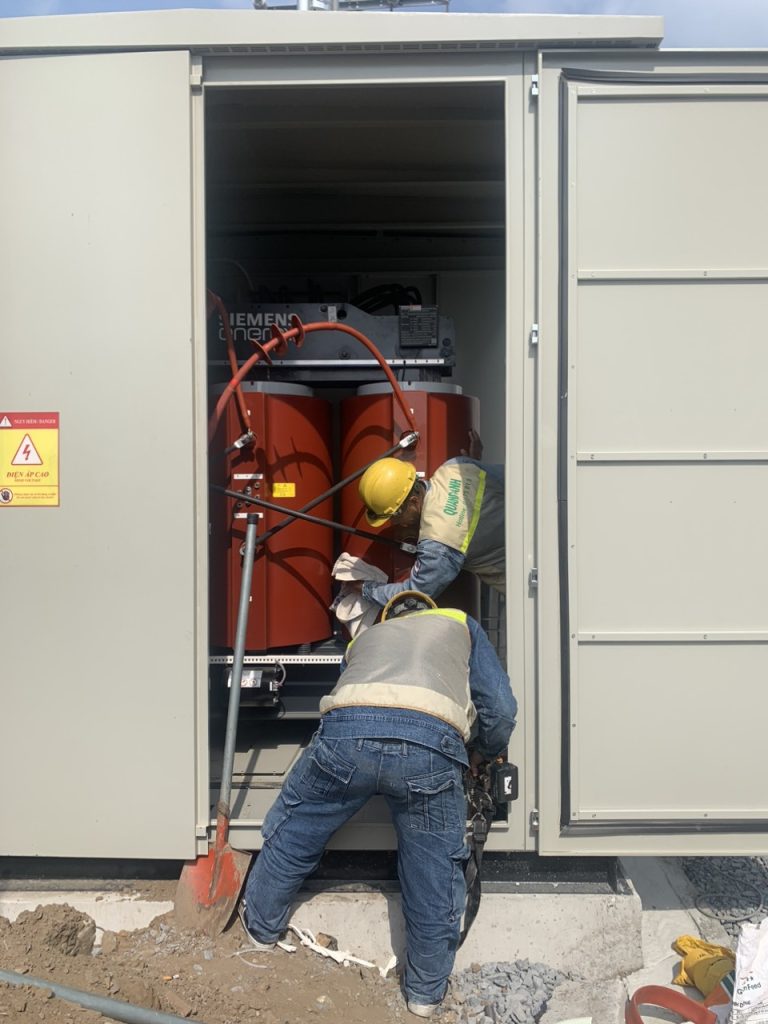
The kiosk 2500 kVA design prioritizes a Siemens dry-type transformer combined with a 1000 kVAr capacitor bank to target a power factor of approximately 0.95–0.98 and reduce reactive power in the distribution system. On site, a dry-type transformer is suitable for enclosed kiosks or indoor locations because it lowers fire risk compared with oil-filled transformers and reduces fire protection requirements. [2][1]
Protection and distribution equipment are arranged so that the main ACB and MSB/MDB 4000 A sit on the secondary side immediately after the transformer, enabling fast isolation and protection of the main distribution block during factory surveys. Verify available short-circuit capacity at the connection point and protection coordination to ensure the 4000 A ACB withstands fault conditions and is compatible with protection relays.
The 1000 kVAr capacitor bank size is selected to compensate reactive power toward ~0.95–0.98; compensation strategy can be staged or automatic (AVR/PLC + capacitor switching) to follow load changes. In practice, measure existing reactive power and harmonic spectrum before installing capacitor banks because overcompensation or compensation in the presence of high harmonics can cause resonance and adverse effects on the system.
Earthing and lightning protection must comply with current guidelines; transformer neutral earthing and a common earthing grid for the kiosk are mandatory for safe operation. Environmentally, dry-type transformers require ventilation and protection from moisture and dust; kiosk dimensions must ensure clearance for insulation and heat dissipation, and include vents or forced ventilation if necessary.
Pre-energization checks and acceptance tests should include the following practical steps after installation:
- Equipment documentation check: catalogues, factory test reports, and standard certificates for the transformer and capacitor bank.
- Mechanical and installation inspection: safety clearances, anchor bolts, door interlocks and kiosk ventilation.
- Electrical tests: insulation resistance measurements, no-load tests and transformer ratio tests; earthing resistance and earth grid continuity tests.
- Protection acceptance: verify relay settings, ACB/MSB coordination, capacitor switching function tests and interlocks.
- Coordinate energization with EVN/local distribution company before applying primary grid power.
On-site surveys are required to validate input data before producing construction drawings and an acceptance program: especially the short-circuit level at the connection point, specific primary/secondary voltages, load profile over time and harmonic spectrum. After obtaining real data, finalize protection settings, select the correct 4000 A ACB/MSB and define a safe compensation strategy to avoid resonance.
22 kV underground cable construction using robotic roadheader and MV connection infrastructure
Robotic roadheader drilling pulls a 3×70 mm2 24 kV underground cable through hot-mix asphalt roads, reducing traffic disruption and minimizing pavement damage within the industrial park.
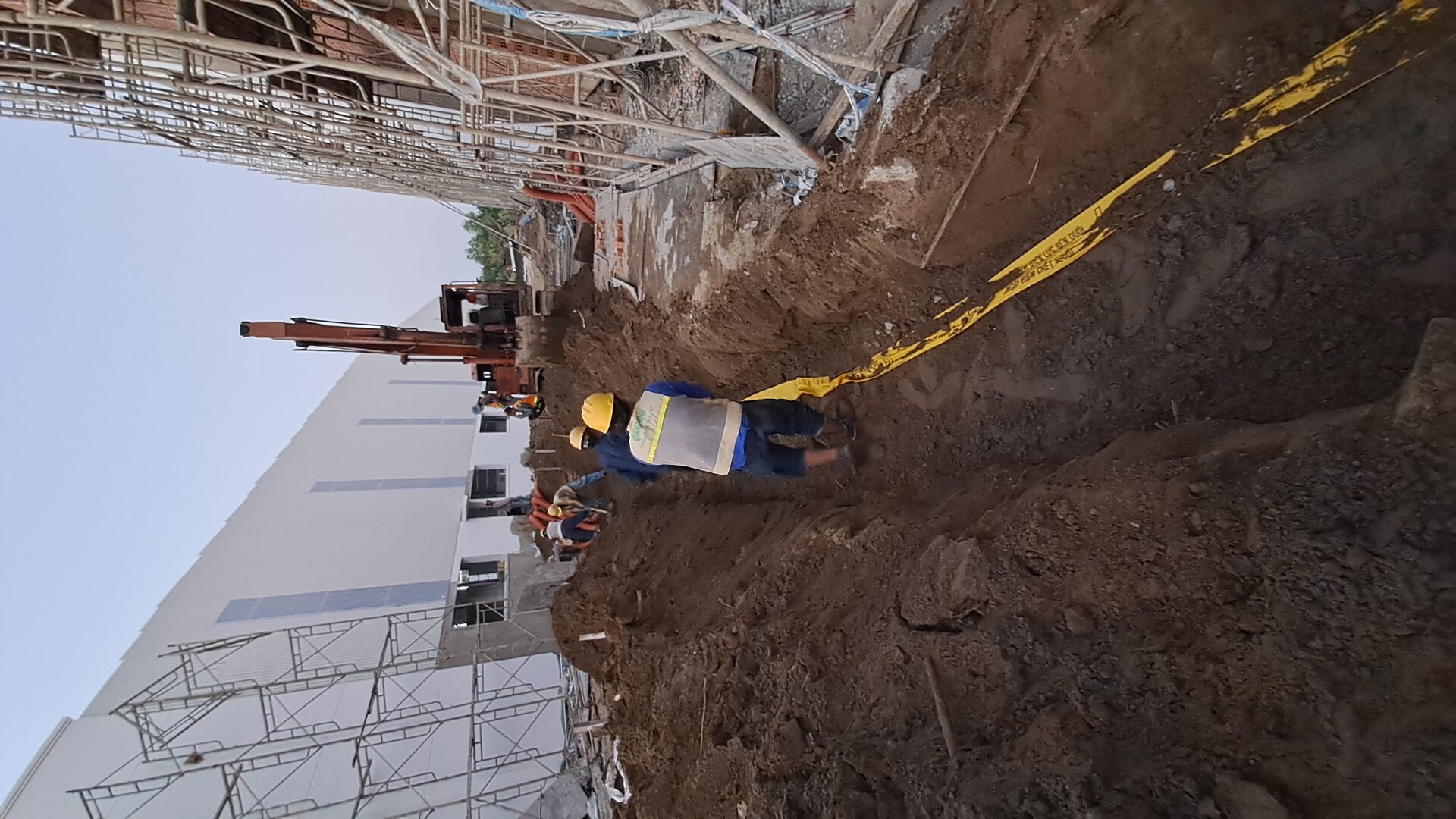
Robotic roadheader is a horizontal drilling method to install conduit and pull a 3×70 mm2 24 kV underground cable through hot-mix asphalt, replacing open trenching in many industrial park cases. On site, this method reduces lane closures and the risk of pavement structure damage compared with open-cut trenches. [0][0]
The construction process typically includes corridor survey, construction permits, preparation of launch and reception pits, horizontal drilling across the road, cleaning the conduit, cable pulling, and road surface restoration. When surveying at the factory, collect roadbed drawings, pavement layer details and positions of existing underground infrastructure to determine the drilling path and reception pit locations.
- Site survey and construction permit, coordinate temporary traffic flow with authorities.
- Prepare launch/reception pits: excavate adequate size, implement measures against collapse and provide drainage.
- Perform horizontal drilling with a robotic/horizontal directional drilling rig; bore across the road and clean the conduit.
- Pull cable through the conduit, apply temporary earthing and safety measures while handling MV cables.
- Inspect the conduit, perform insulation checks on the cable and restore the road surface per procedure.
Drilling equipment selection criteria include the drill head diameter compatible with conduit and cable cross-section, maximum pull force for 3×70 mm2 cable, steering capability for horizontal drilling, and ability to operate in asphalt or mixed soils. During works, take measures against sinkage or voids if groundwater pockets or dense aggregate layers are encountered under the road.
- Verify pavement structure and existing underground utilities before drilling.
- Ensure temporary earthing and electrical contact protection for workers when pulling MV cables.
- Schedule work during off-peak hours or nights, provide signage and a traffic safety team on site.
For acceptance and post-construction checks, inspect cracks or subsidence on the road, conduit straightness/free of kinks, and the cable insulation parameters after installation. For MV connection acceptance, coordinate closely with EVN or the grid operator to organize safe switching operations and meet connection requirements.
Operational caution: incorrect drilling techniques may compress or kink the conduit or damage pavement structure; have contingency plans to switch to mechanical cutting or core-drilling if thick concrete or rock layers are encountered. Road restoration quality and site aesthetics are non-negotiable acceptance criteria in the industrial park at the end of works.
Kiosk installation, LV cable pulling, testing, acceptance and energization; factory checklist
Details of installing the Siemens dry-type transformer 2500 kVA, pulling 300 mm2 LV cable, testing, acceptance and coordination of energization with the investor and the power utility.
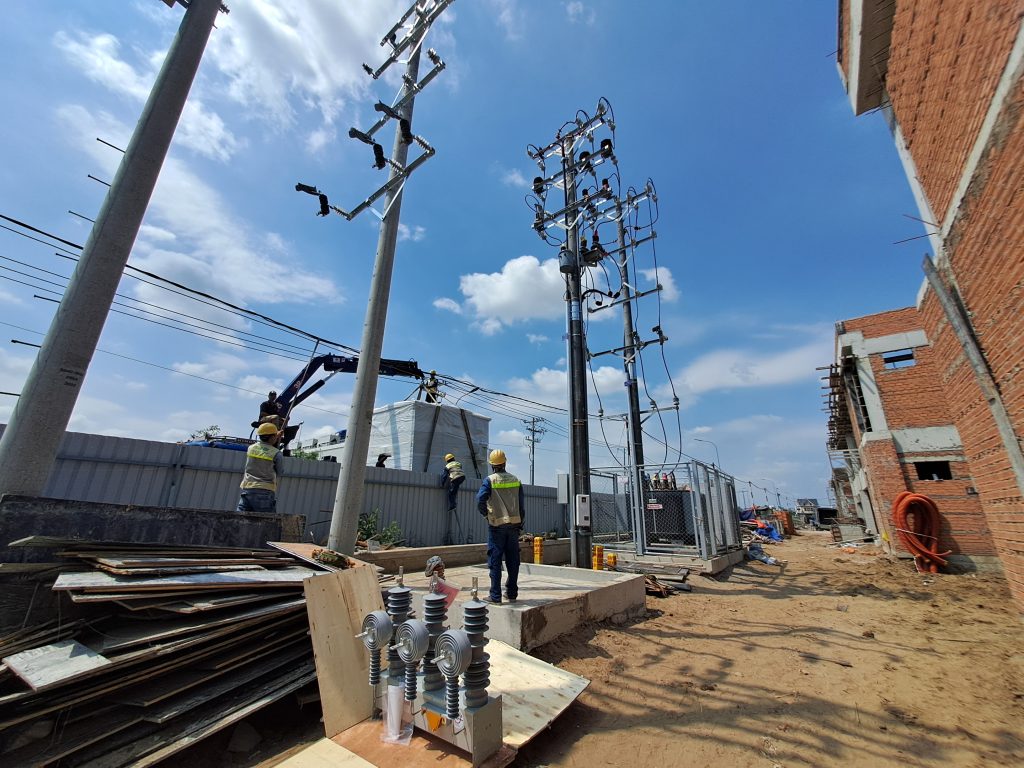
Completed installation included a Siemens dry-type transformer 2500 kVA, 3P ACB 4000 A 100 kA, MDB/MSB 4000 A, an approximate 1000 kVAr capacitor bank, nearly 1000 m of 300 mm2 LV cable and five MV underground cable terminations. [0][0]
On site, the basic principles for dry-type transformers are to check placement, foundation, ventilation and safety clearances before lifting; the foundation, anchor points and kiosk openings must allow airflow and avoid heat accumulation. During factory surveys verify minimum clearances around the transformer, access for equipment transport, lifting schemes and anti-rolling measures, while controlling handling to avoid mechanical shock to windings.
Pulling 300 mm2 LV cables requires appropriate conduits, cable trays or steel conduits, labeling at each cable end and records of joint locations. For pull force limits and jointing, refer to the cable manufacturer’s catalogue and requirements; during on-site works and acceptance perform continuity and insulation checks before and after pulling. Influencing factors include the nearly 1000 m length, number of bends, underground joints and transition points.
Pre-energization test procedures include mechanical inspection, insulation resistance measurement (Megger/IR), earth resistance testing, phase separation tests and functional testing of ACBs. The capacitor bank must have its connections, controller and automatic switching functions tested. For relay/ACB commissioning, prepare a clear test list, record step-by-step minutes and archive test results (Megger, IR, earth measurement, ACB functional tests).
Acceptance coordination typically assigns responsibilities: the investor provides equipment documentation and approves the energization plan, the contractor performs installation and tests, and the utility/testing unit (EVN) carries out inspections/energization as required. Energization acceptance must include minutes, test results and equipment receiving documents; note that the internal energization milestone 28/03/2023 is declared internally — project minutes are required for verification.
- Preparation checklist for the investor when requesting quotations:
- acceptance/receiving dossier (PO, factory certificates, equipment serial numbers);
- list of main equipment and single-line diagram;
- as-built drawing expectations for cable routes, joint locations and earthing points;
- energization plan with isolation procedures, lockout/isolation requirements and coordination requests with the utility;
- lifting and cable-pulling safety plan, overload protection devices;
- proposed acceptance schedule and list of test instruments required.
Operational risks and safety requirements include verifying the earthing system before energization, applying safety labels, performing lockout/tagout (LOTO) procedures during works, and having emergency contact arrangements with the utility in case of isolation or incidents. Legally and operationally, note requirements for measuring and trading reactive power when capacitor banks are present according to relevant circulars; after energization perform trial runs, load monitoring and power quality checks following EVN’s power facility testing procedures.
To finalize construction method, acceptance schedule and accurate quotations, perform an on-site survey, provide detailed cable route drawings, equipment catalogues and any acceptance/energization minutes if available; missing documents will require recalculating cable pulling volumes, number of joints and earthing schemes before signing contracts.
The 2500 kVA kiosk substation project for Bericap illustrates a turnkey construction approach suitable for factories in industrial parks: ensuring a safe 22 kV connection, reducing traffic impact via robotic roadheader drilling and improving LV operation with a 1000 kVAr capacitor bank. Investors can use the checklist and equipment schedule provided to request quotations and evaluate contractors.
Frequently asked questions
What type of factory is a 2500 kVA substation suitable for?
A 2500 kVA substation suits medium–large industrial factories with high peak loads (motors, compressors, production lines) and requiring expansion reserves. To finalize the solution supply current/future load dossiers (kW/kVA), power factor, diversity factor and starting characteristics.
Why did the Bericap project use a 2500 kVA kiosk substation?
Bericap chose a kiosk substation for compact footprint, fast installation and suitability within an industrial park; a dry-type transformer reduces fire risk and PCCC requirements compared to oil units. To confirm the choice provide layout drawings, connection point and operational requirements from the investor.
What are the benefits of robotic roadheader drilling for 22 kV underground cables?
Robotic roadheader drilling reduces pavement damage, limits traffic disruption, shortens construction time and preserves aesthetics compared with open-cut trenching. The decision requires checking geology, road composition, route length and drilling equipment specs to ensure feasibility.
What is the purpose of a 24 kV 630 A recloser in the Bericap substation?
The 24 kV 630 A recloser protects the MV branch: it isolates faults and performs automatic reclose operations to reduce outage duration and improve selectivity before manual intervention. Configuration requires knowledge of fault current levels, circuit layout and protection coordination with the utility.
What roles do the 4000 A ACB and MDB/MSB have on the LV side?
The 4000 A ACB is the main LV breaker providing fault interruption and isolation; MDB/MSB 4000 A distributes power to downstream feeders and houses protection and control. Detailed device selection requires load schedules, cable runs and fault current calculations at the installation point.
How does a 1000 kVAr capacitor bank help the factory?
A 1000 kVAr capacitor bank compensates reactive power, improves power factor, reduces losses and voltage drop, and lowers the risk of penalties for poor power factor. Before sizing compensation, obtain actual power factor data, load profiles and harmonic analysis to avoid adverse effects.
Checklist to prepare a quotation request for a 2500 kVA substation
- Determine current and future capacity needs (kW/kVA) and allocate by production areas.
- Provide the proposed substation location & site drawing, 22 kV connection point and underground cable route.
- Prepare a list of main loads, desired power factor and capacitor bank requirements (indicate desire for a 1000 kVAr bank if applicable).
- Specify substation type (kiosk), transformer type (e.g. dry-type 2500 kVA if oil-free preferred) and desired ACB/MDB specifications (e.g. 4000 A ACB).
- Request the contractor to provide a detailed construction timeline, acceptance milestones and a main equipment list with documents/suppliers.
- Specify the preferred underground cable construction method (e.g. robotic roadheader) to evaluate traffic impact and aesthetics.
- Prepare documents for coordinated acceptance with the local utility (contact information, road work permits if required).
Contact QuangAnhcons to receive capability dossiers, detailed equipment lists and a technical proposal suited for your 2500 kVA substation.
References (18)
Reference principle: all technical claims, timelines and equipment specifications must be supported by public sources or verifiable internal documents. Priority official sources: QuangAnhcons project pages/quanganhcgte, thicongtrambienap, English project pages quanganhcons.com, videos/LinkedIn listed in intake, and regulatory documents (EVN, Ministry circulars, QCVN/TCVN, IEC/IEEE as needed). Do not use vendor marketing as legal evidence; financial figures or acceptance minutes are only recorded when verifiable. Each important claim (energization date, equipment type, cable length, milestone) must be mapped to the internal source_fact_map before publication.
- Technical guidance/standards for insulating equipment and transformers (industry TCVN) | TCVN. (status: background). ([tcvn.gov.vn]( )) | 2015 |
Standards/regulatory documents used to reference technical requirements in the article.
- TCVN transformer / building electrical installation standards | TCVN (list of national standards relevant to substations and electrical installations). (status: background/current depending on document). ([tcvn.gov.vn]( )) | 2020 |
Standards/regulatory documents used to reference technical requirements in the article.
- TCVN02122019
Standards/regulatory documents used to reference technical requirements in the article.
- Draft QCVN for EV charging poles . .
Official sources from tcvn.gov.vn used to verify referenced technical regulations.
- Guidance on applying TCVN for electric vehicles
Official sources for technical reference in the article.
- tcvn.gov.vn
Official sources for technical reference in the article.
- Improvements to TCVN system contributing to safety and consumer battery quality management
Official sources for technical reference in the article.
- QCVN 26? | Technical regulations — Power grid system | Ministry of Industry & Trade / EVN | (EVN provided QCVN PDF). (status: current / EVN reference). ([evn.com.vn]( )) | 2025 |
Standards/regulatory documents used to reference technical requirements in the article.
- AP012025
Standards/regulatory documents used to reference technical requirements in the article.
- Experience improving productivity and quality at PC Quang Ngai
Standards/regulatory documents used to reference technical requirements in the article.
- Guidelines and experience sharing on lithium-ion battery safety
Official sources for reference in the article.
- National technical regulations on EV charging poles to be officially issued
Official sources for reference in the article.
- Tightening standards for EV charging stations in residential areas to ensure safety from design to operation
Official sources for reference in the article.
- Amendments supplementing metering regulations for group-2 measuring instruments
Official sources for reference in the article.
- Enhancing safety for factories and hazardous chemical storage per new standards
Official sources for reference in the article.
- Safety standards for consumer battery products
Official sources for reference in the article.
- Standardization and safety management for household installation devices
Official sources for reference in the article.
- Standardization and safety management for household electrical and electronic devices
Official sources for reference in the article.
Substation budget estimate
Select the capacity, route lengths and package to view your indicative budget and electrical parameters.
Request a project quotation
Send your project details, BOQ or drawings to request a formal quotation. Fields marked * are required.
Quotation scope
Applies to one EVN-supplied substation with oil-immersed transformers at 22/0.4 kV (single-phase: 12.7/0.23 kV), with MV metering VTs/CTs supplied by EVN. The estimate includes the selected equipment, installation, earthing, transformer-to-main-breaker connections, design and connection documentation, and coordination of testing and utility acceptance.
Kiosk, integrated steel-pole and indoor substations include MV switchgear and the entered underground cable route. Other outdoor arrangements use the relevant protection configuration. The final diagram must meet the project connection requirements.
Excludes VAT, cables from the substation switchboard to the MSB/loads, live-line work, harmonic reactors, weak-ground treatment or special piling, land and special fire-protection provisions. Underground routes assume normal construction conditions and exclude road drilling and special reinstatement.
Prices are indicative investment budgets. A formal quotation follows site assessment and agreement on the configuration. Electrical selections are preliminary and require design verification before installation.
Capacity range and application conditions
The catalogue defines the enquiry range of this tool, not universal TCVN capacity limits. Single pole-mounted transformers: 15–100 kVA; three-unit banks: 3×15–3×100 kVA. Platform substations: 100–630 kVA. Steel-pole substations: 100–630 kVA; 750/800 kVA require design verification and local approval. Ground-mounted, kiosk and indoor configurations: 50–10,000 kVA. Not every configuration has a package price or the same structural design.
Reference: EVN Decision 1299/QD-EVN dated 3 November 2017, Volume 1, sections 3.3–3.4. Check the current requirements of the responsible utility before implementation. Kiosks must meet manufacturer ratings and testing requirements (IEC 62271-202); indoor and ground-mounted arrangements must meet project layout, ventilation, structural and fire-protection requirements. For multiple transformers, specify the quantity and capacity of each unit.
Developed by QuangAnhcons · © 2026 QuangAnhcons. Code licensed under GPL-2.0-or-later. Standards and manufacturer data belong to their respective owners.