Tiếng Việt
 简体中文
简体中文 Deutsch
 日本語
日本語 한국어
한국어 ไทย
ไทย Русский
 Français

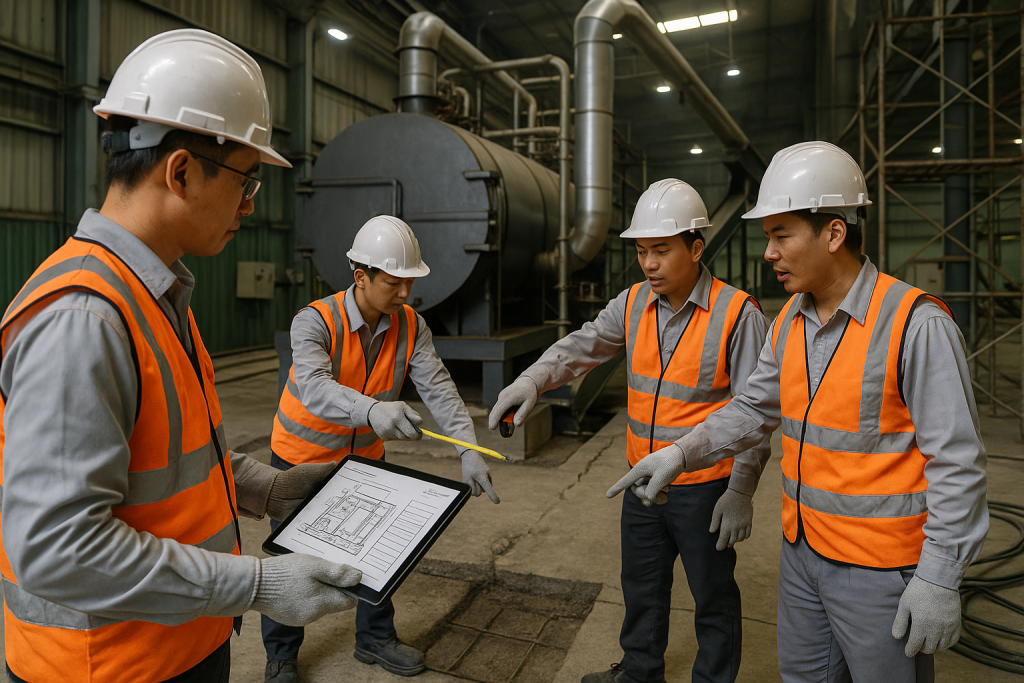
- Quickly grasp the main modules of a biomass boiler and the role of each part in an industrial steam line.
- Understand combustion and steam generation principles to assess whether a boiler is suitable or has operational bottlenecks.
- Identify auxiliary systems that are nearly indispensable to run the boiler stably, reduce downtime and control emissions.
- Distinguish when to prefer chain-grate or fluidized bed based on fuel characteristics and plant requirements.
- Know the technical signs to survey before investing, refurbishing or optimizing an existing system.
Who is this article for?
- Investors and plant management considering biomass boiler solutions.
- Utility, maintenance and operations teams responsible for steam systems.
- Project teams reviewing the scope of main and auxiliary equipment before engaging technical vendors.
- Plants using biomass fuel that want to reassess stability, efficiency or refurbishment options.
When to read this?
- When you need a quick understanding of what a biomass boiler includes before the investment survey stage.
- When an existing boiler has unstable combustion, high ash/dust or fluctuating steam load.
- When you must identify mandatory auxiliary systems to avoid missing items in technical specifications.
- When choosing between chain-grate and fluidized bed configurations for specific fuel conditions.
- 1. What modules does a biomass boiler in a plant actually consist of
- 2. Main construction of a biomass boiler and the path of heat: biomass boiler
- 3. Combustion and steam generation principle: from fuel to usable steam: biomass boiler
- 4. Mandatory auxiliary systems for stable and safe boiler operation: biomass boiler
- 5. Signs that the boiler configuration or auxiliaries are unsuitable: biomass boiler
- 6. Choosing chain-grate or fluidized bed according to fuel and operational goals: biomass boiler
- 7. Site survey procedure before new investment or refurbishment: biomass boiler
- 8. Scope of work and factors affecting cost and schedule: biomass boiler
For plants requiring industrial steam, a biomass boiler is not just the combustion chamber and boiler body but a system of tightly linked modules from fuel feeding, steam generation to emissions and ash handling. Misunderstanding the structure or omitting auxiliaries can easily lead to unstable operation, high fuel consumption or environmental issues at commissioning.
1. What modules does a biomass boiler in a plant actually consist of
Define a biomass boiler as a complete system comprising combustion, steam generation, fuel feeding, control and post-combustion handling, to avoid viewing the project as a single device.
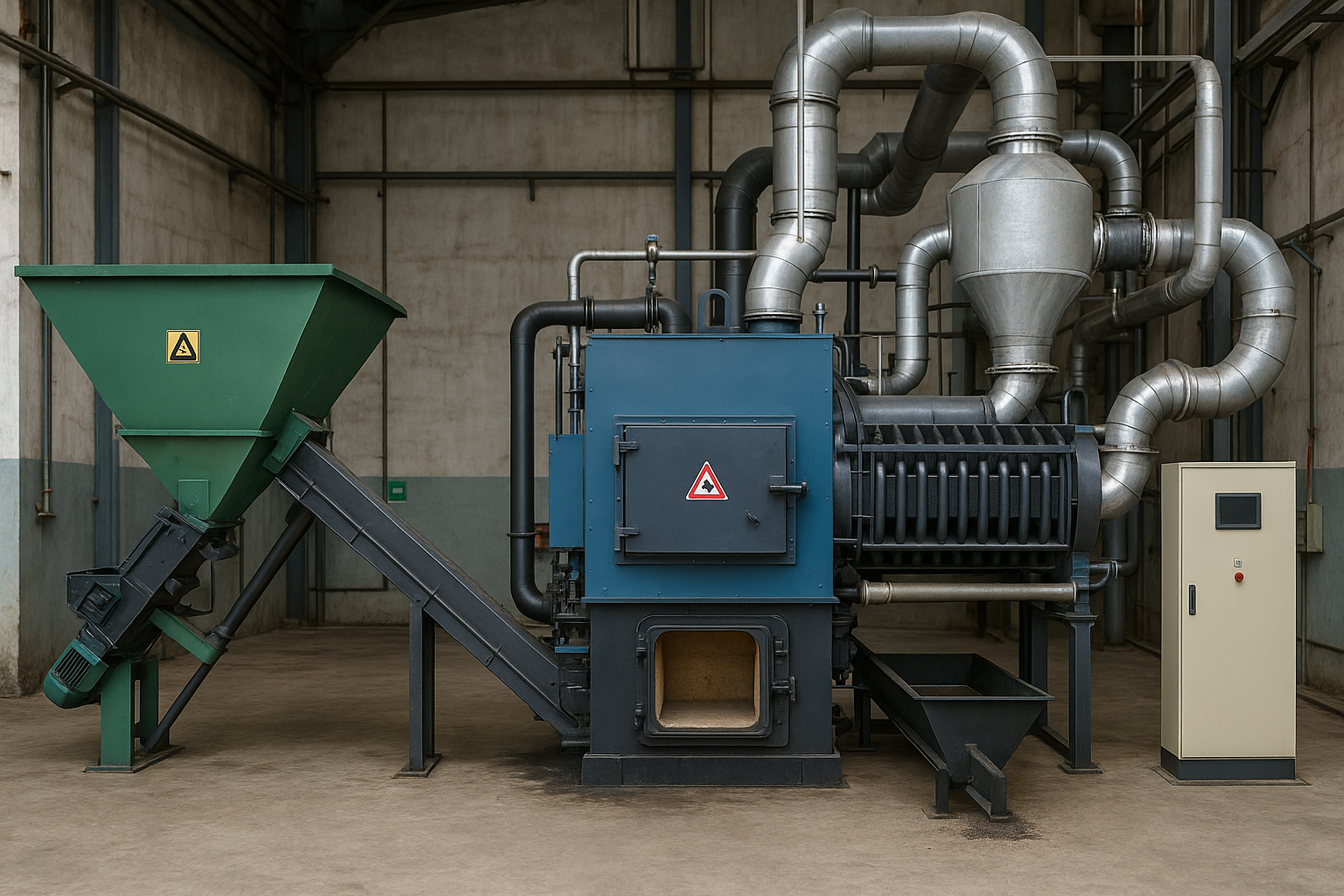
A biomass boiler in a plant is a combination of multiple functional blocks, including fuel feeding, combustion chamber, steam generation, emissions treatment and ash handling.
biomass boiler: key field assessment points
The overall configuration varies with fuel type, capacity and site layout, so field assessment is required when preparing the design.
- Fuel feeding: hopper, screw conveyor, belt conveyor, feed valves to deliver fuel evenly into the combustion chamber.
- Combustion chamber: grate distributing air to create a fluidized bed or fixed grate depending on technology.
- Steam generation: waterwall tube bundle and convective tube bank to generate saturated steam.
- Emissions treatment: dust filter, draft fan and settling/treatment tanks to reduce emissions.
- Ash disposal: ash collection system, discharge screws or ash hoppers to avoid buildup affecting performance.
- Control and safety: PLC/SCADA monitoring pressure, temperature, water level and fuel feed.
biomass boiler: operational notes and implementation decisions
The fuel feeding system includes hopper, screw conveyors, belt conveyors and feed valves to deliver biomass fuel uniformly into the combustion chamber.
.. At the site, check hopper levels, wear on feed screws and belt synchronization during shifts to avoid uneven feeding causing unstable combustion.
The combustion chamber often uses a grate that distributes air to create a fluidized layer, supporting efficient combustion of biomass. Primary and secondary fans supply air to different combustion zones.
During maintenance shifts, inspect grate gaps, fan operation and draft thresholds as practical tasks to maintain combustion performance.
The boiler body and steam generation components include waterwall tubes and convective tube banks where radiative and convective heat transfer converts water into steam. Steam piping with safety valves and air heaters are mandatory auxiliary modules.
.. When surveying on-site, arrange tube banks and tube lengths according to installation space and acceptance requirements, depending on model and operating conditions.
The flue gas treatment system typically includes a dust filter, draft fan and settling tanks to reduce emissions. The ash handling system collects ash from the combustion chamber to prevent accumulation that affects performance.
Operational warning: ash buildup or clogged filters will increase pressure losses and reduce efficiency. Therefore periodic inspection and ash removal during shifts are necessary.
The automatic control system monitors pressure, temperature, water level and fuel flow to ensure safety. Final decisions on detailed configuration require on-site survey and fuel type confirmation.
2. Main construction of a biomass boiler and the path of heat: biomass boiler
Helps visualize parts such as the combustion chamber, grate or fluidized bed, steam drum, steam tubes, superheater and heat exchange surfaces to understand which parts determine steam generation capability.
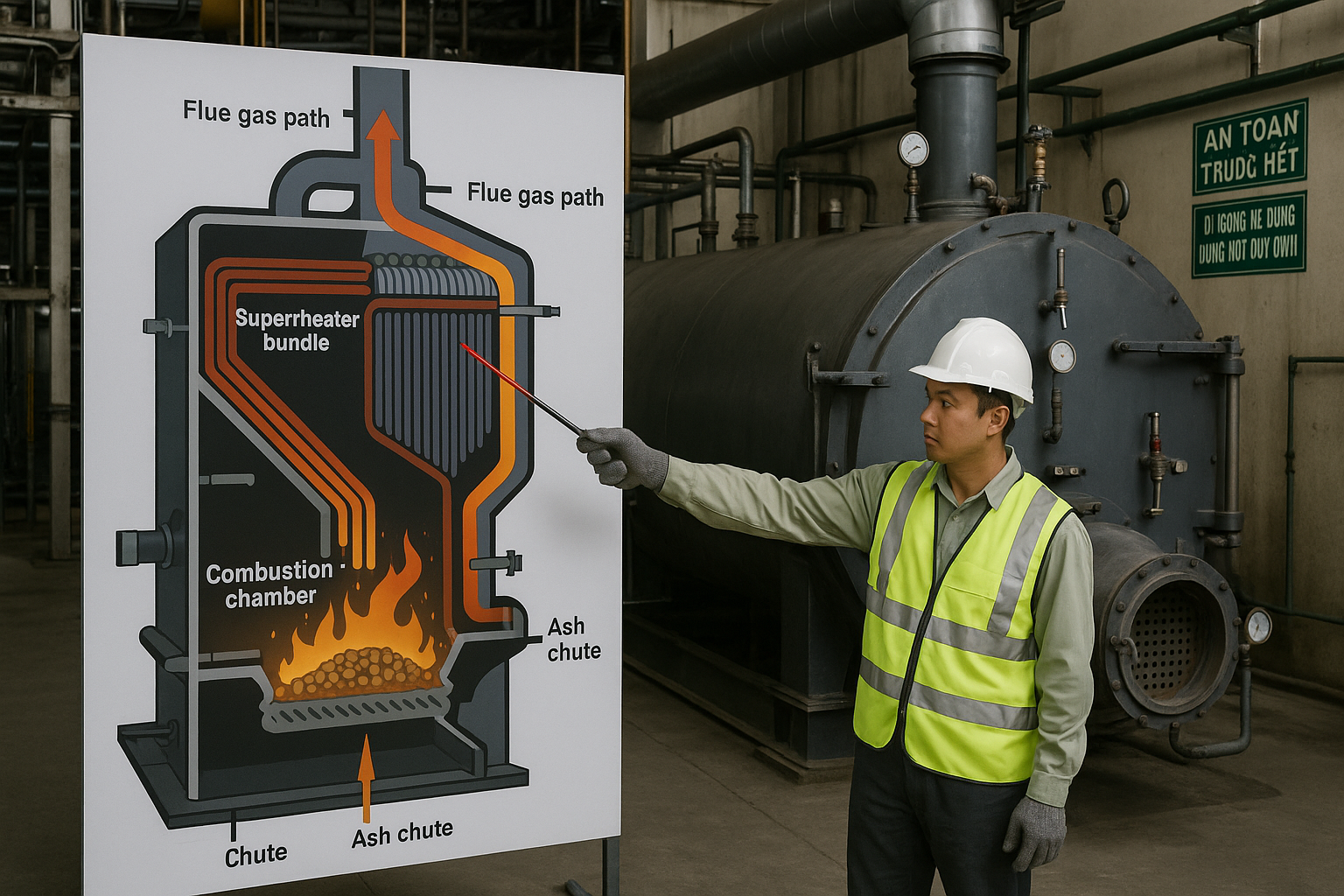
Biomass boilers typically divide into three main parts: the furnace system with combustion chamber, fuel feeding system and flue gas treatment system.
biomass boiler: key field assessment points
Structurally, the combustion chamber contains an air-distributing grate or fluidized bed to create and maintain uniform combustion. During maintenance, observe the fluidized bed and air distribution: the grate must support inert material and distribute air evenly to avoid local overburn or poorly burning zones that cause heavy soot.
The fuel feeding system comprises hopper, screw conveyors, feed valves and belt conveyors responsible for delivering fuel continuously into the combustion chamber at appropriate flow and distribution. In practice, adjusting screw speed and feed valves is the direct operation to balance air/fuel ratio.
biomass boiler: operational notes and implementation decisions
- Waterwall tubes (front, rear, side) absorb radiative heat directly from the flame in the combustion chamber.
- Combustion products pass through the rear flue opening into the convective tube bank for convective heat exchange.
- The steam drum (boiler body and steam-generating parts) collects saturated steam from heat transfer surfaces; this steam can go through a superheater if higher temperature/pressure is needed.
Primary fan supplies air under the grate to create and maintain the fluidized bed, while the secondary fan supplies air above the combustion chamber to complete combustion of lighter particles. Checking fan duct pressure and uniformity of air flow is an important field inspection criterion.
Flue gas after heat exchange is treated through dust filters and settling tanks before discharge. Incorrect gas flow or fuel feeding can increase dust loading and reduce heat exchange efficiency. Therefore adjust according to load and fuel type.
Summary of heat path: radiation from the combustion chamber to waterwall tubes → hot gases enter convective tube bank for convective exchange → heat transfer surfaces generate saturated steam → if required, steam passes through superheater tubes. Depending on model and operating conditions, the order and proportion of radiation and convection heat transfer may vary, so on-site survey is needed during design or optimization.
Operational warning: simultaneous control of air supply and feed rate is decisive to avoid uneven combustion, increased soot or convective tube bank blockage. If design tuning or sizing of heat transfer surfaces is required, conduct detailed on-site survey and evaluate the fuel used.
3. Combustion and steam generation principle: from fuel to usable steam: biomass boiler
Helps assess how the boiler works from fuel feeding, combustion in the chamber to water-steam circulation, thus understanding why steam load, fuel quality and heat transfer must be considered together.
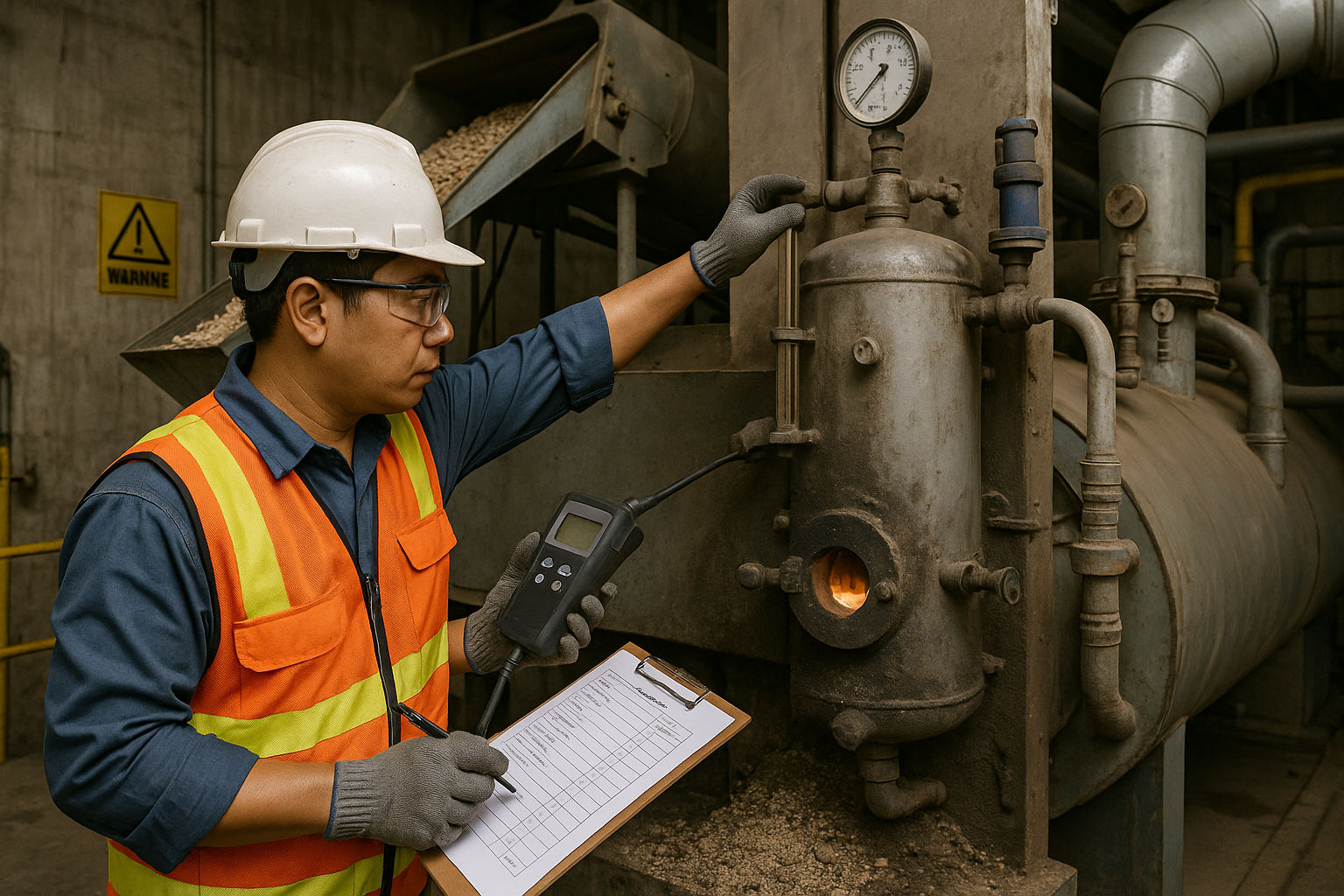
Steam generation in a biomass boiler starts with feeding fuel via screw conveyor, followed by combustion in the chamber or fluidized bed, radiative heat transfer to the waterwall tubes and finishes with convective heat exchange in the tube bank to generate steam.
biomass boiler: key field assessment points
Saturated steam is separated from the drum before being routed to use points or passing through a superheater if higher temperature and pressure are required. During operation, stable steam load requires balance among feed rate, air distribution and heat exchange efficiency.
In practice, biomass fuel is fed by screw conveyor combined with blowers for distribution. Primary air from below creates the fluidized layer with inert material, while secondary air above helps burn light unburned particles.
biomass boiler: operational notes and implementation decisions
These factors determine heat transfer mechanisms: radiation dominates on waterwall tubes around the combustion chamber while convection dominates in the rear convective tube bank… When surveying on-site, measure temperature profile of tube zones to identify areas with poor heat transfer.
During maintenance or operation checks, observe the following field signals before making adjustments:
- Uneven fuel distribution on the grate or in the fluidized bed, causing loss of uniformity;
- Unburned fuel appearing in the upper chamber or increased ash/dust;
- Pressure, steam temperature or flow fluctuations indicating issues with water circulation, feed pump or steam separator;
- Uneven waterwall tube temperatures indicating imbalanced radiative/convective heat transfer.
Water circulation is maintained by the feedwater pump. Meanwhile the feedwater heater recovers waste heat to preheat feed water before entering the boiler, increasing steam generation efficiency and reducing thermal load on the combustion chamber. Check feed pumps and feedwater heater during maintenance to detect pressure drops or reduced heat exchange performance.
Operational adjustments usually revolve around feed rate and air distribution. Adjusting screw speed and tuning the FD fan will directly affect combustion efficiency and steam load. Practical warning: maintain a uniform bed or grate layer and avoid overfeeding or underfeeding to reduce fuel loss and incomplete combustion.
.. When surveying the plant to optimize the system, measure temperature profiles, check bed uniformity and evaluate feedwater heater performance before changing feed speeds or tuning fans. These observations determine the next calibration steps to stabilize steam production.
4. Mandatory auxiliary systems for stable and safe boiler operation: biomass boiler
Helps finalize the minimum scope required around the boiler such as automatic fuel feeding, fans, heat recovery, emissions treatment, ash handling and PLC control to avoid missing items when investing or refurbishing.
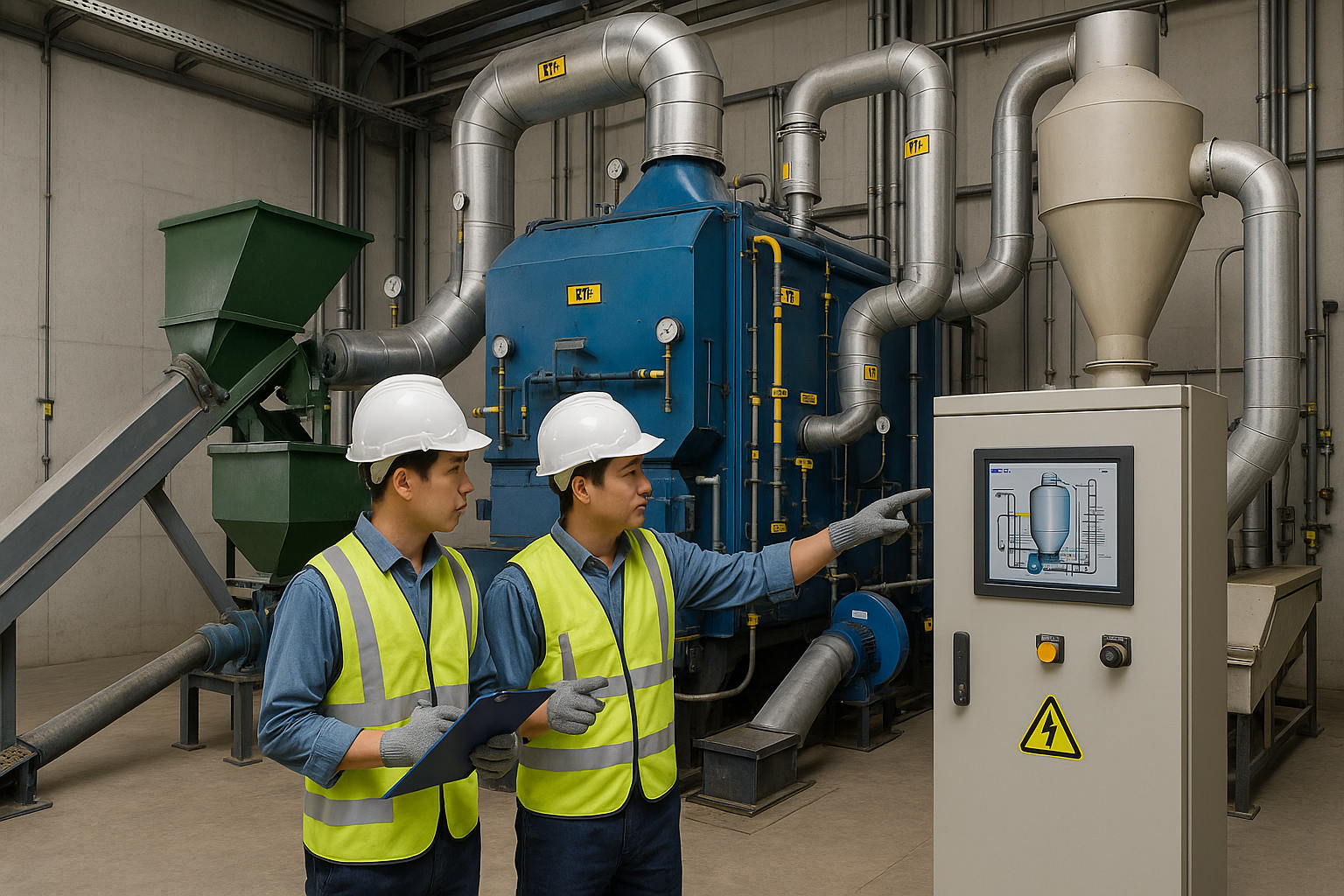
Minimum auxiliary systems for a biomass boiler include automatic fuel feeding, forced and induced draft fans, heat exchangers, emissions treatment, ash handling and PLC control to ensure stable and safe operation.
biomass boiler: key field assessment points
The automatic feeding system typically comprises hopper, screw conveyors, feed valves and blowers to deliver biomass fuel into the combustion chamber at a steady rate… On-site, during maintenance shifts check hopper levels, feed screw condition and fan flow to detect blockages or shortages in time.
The forced draft (FD) fan supplies clean air into the combustion chamber to create conditions for a stable bed and combustion. The induced draft (ID) fan maintains negative pressure, extracts flue gas and ensures system safety. The air distribution grate must be checked to ensure even air distribution below and above the combustion chamber;.. when surveying the plant observe distribution status and adjust baffles or dampers if needed.
biomass boiler: operational notes and implementation decisions
The economizer recovers waste heat from flue gases to heat feedwater, while an air preheater uses flue gas heat to preheat combustion air. Both devices improve heat exchange efficiency and reduce fuel consumption. During operation or acceptance tests, check performance by observing flue gas inlet/outlet temperature differences and inspect surfaces for fouling.
- Automatic fuel feeding system: hopper, screw conveyors, feed valves, blowers.
- Forced draft (FD) and induced draft (ID) fans with air distribution grate.
- Economizer and air preheater for waste heat recovery.
- Emissions treatment: dust filter, settling tanks and draft fan.
- Automatic ash disposal and ash collection mechanism.
- Feedwater pumps, water treatment and steam separators/superheaters.
- PLC control system to monitor water level, pressure and temperature.
The emissions treatment system must include a dust filter and draft fan to control dust and harmful gases before discharge. During maintenance monitor pressure drop across the filter to determine cleaning or replacement intervals. The automatic ash disposal prevents ash accumulation and maintains combustion performance. When surveying the site check ash extraction mechanisms and conveyor/collection status.
Operational warning: lack of an induced draft fan (ID Fan) or emissions treatment can lead to positive pressure in the combustion chamber and uncontrolled emissions, which must be addressed immediately. Feedwater pumps and water treatment work with PLC to maintain water level, avoid scaling and corrosion. The PLC continuously monitors safety parameters and actuates equipment according to protection logic.
To finalize design and investment scope, survey the site, determine fuel characteristics, hopper capacity and emissions requirements. This information determines screw sizing, fan power, economizer type and appropriate emissions treatment configuration.
5. Signs that the boiler configuration or auxiliaries are unsuitable: biomass boiler
Helps identify symptoms such as unstable combustion, high ash/slag, heavy dust emissions, fluctuating steam load or operation heavily dependent on manual interventions to decide which area to inspect first.
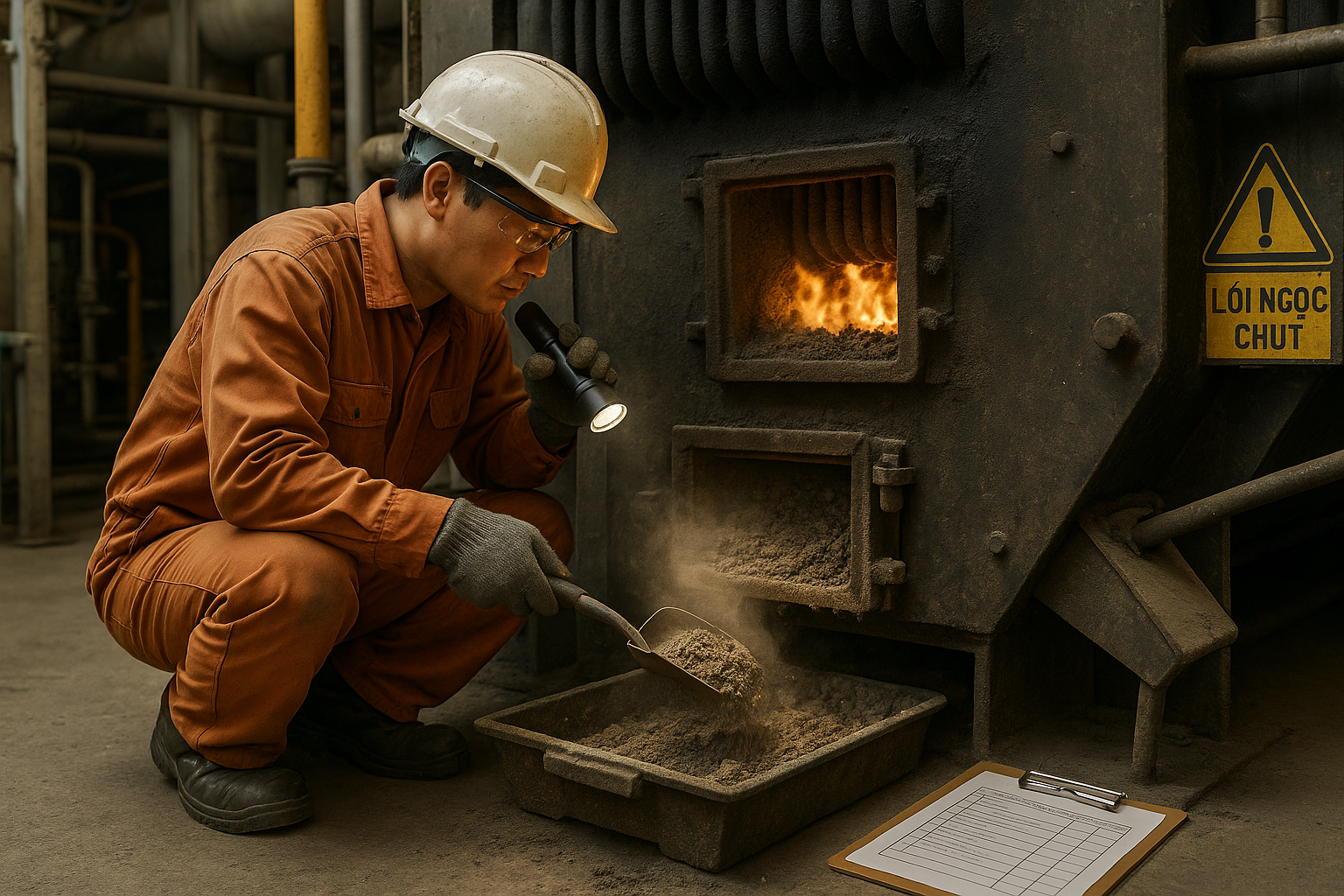
Typical signs are unstable combustion, excessive ash/slag, high dust emissions and fluctuating steam load.
biomass boiler: key field assessment points
Unstable combustion is often due to uneven manual feeding or uneven air distribution, causing combustion chamber temperature swings and reduced efficiency. During maintenance, if manual feeding interventions are frequent that indicates lack of automation to be addressed.
Excessive ash/slag often occurs when air supply is insufficient or incorrectly distributed in a fluidized bed. High dust emissions indicate poor flue gas treatment, such as clogged dust filters or ineffectively operating economizer. Fluctuating steam load may arise if fuel feed rate is not automatically controlled or feedwater pumps fail to maintain stable levels.
biomass boiler: operational notes and implementation decisions
- Check level of automation in fuel feeding and the frequency of manual interventions during shifts.
- Measure and record air distribution upstream to assess bed state and distribution of primary/secondary air.
- Check balance and performance of FD and ID fans, as imbalance causes unstable draft.
- Check fuel size and risk of screw conveyor blockage when steam load is intermittent.
- Check economizer and dust filters if high dust emissions are observed.
- Check feedwater pumps and level control when steam fluctuations coincide with poor feeding.
Operational warning: lack of automatic fuel feeding increases labor safety risks and downtime, so prioritize addressing this after confirming site conditions. Depending on model and operating conditions, conduct a field survey to set repair or upgrade priorities.
6. Choosing chain-grate or fluidized bed according to fuel and operational goals: biomass boiler
Supports choosing the most suitable boiler configuration based on biomass fuel characteristics, load fluctuation, steam stability requirements and investment capability for auxiliaries, rather than following general trends.
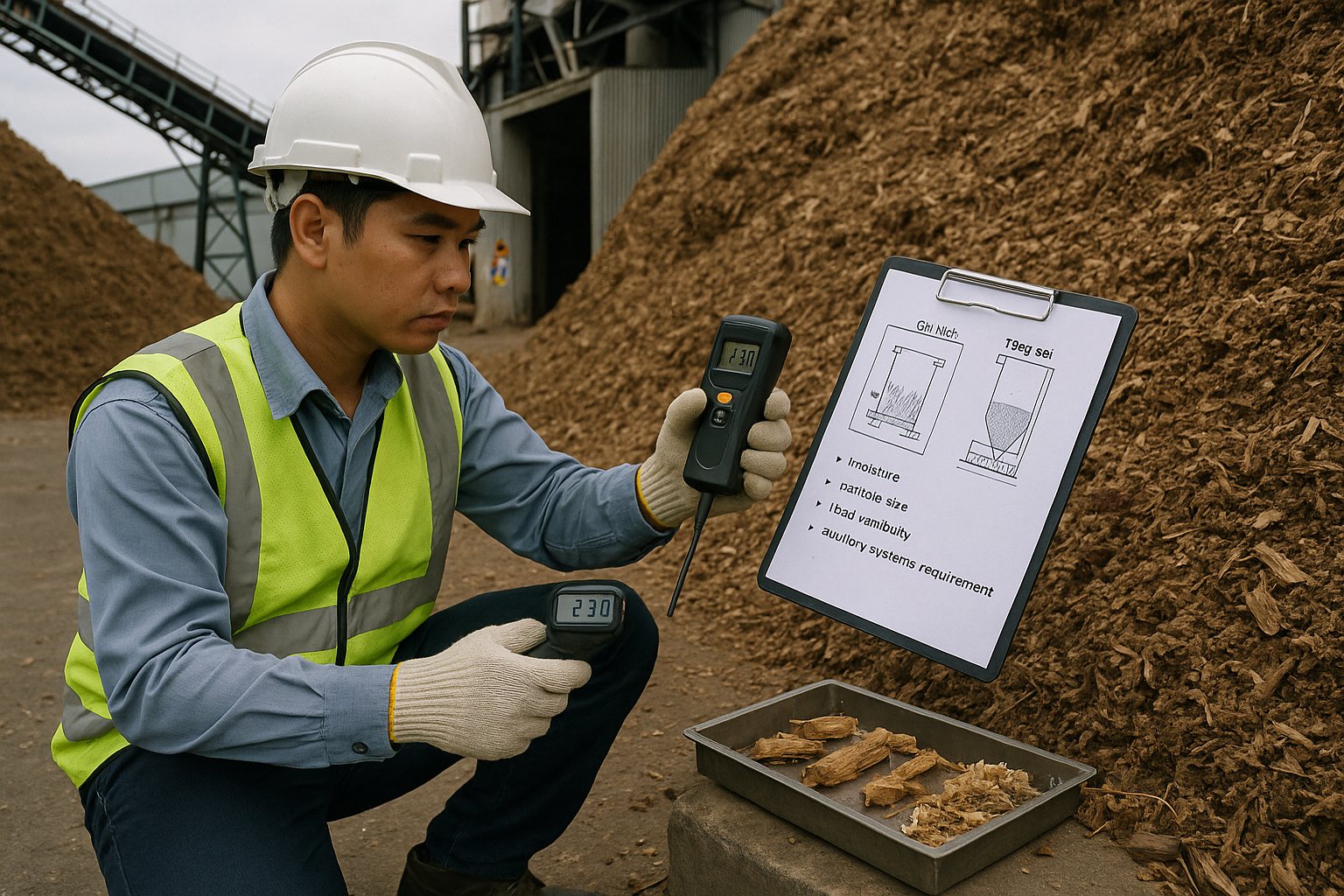
Choose chain-grate boilers when fuel has large particle size or high moisture and when steam load is relatively stable. Choose fluidized bed (CFB) when fuel is diverse, load fluctuates significantly or priority is combustion optimization and lower emissions.
biomass boiler: key field assessment points
Technically, chain-grate distributes fuel by layers, using resistance to distribute air evenly and maintain stable combustion at low loads. Fluidized bed creates a uniform fluidized state by primary air from the bottom and secondary air above the chamber, while supporting the fuel-sand-ash mixture to improve heat transfer… When surveying on-site check particle size, fuel moisture and load swing in shifts to determine technology suitability.
Operational and auxiliary differences are clear: chain-grate typically has simpler auxiliaries and suits when capital cost is prioritized. In contrast, fluidized bed requires more complex feeding systems, fans and control equipment to manage the bed. During acceptance or trial runs, observe steam stability, ash levels and pressure fluctuation to get clear signals about the chosen configuration. Operational warning: if fuel is heterogeneous or contains many contaminants, chain-grate may clog while fluidized bed will require proper ash handling.
biomass boiler: operational notes and implementation decisions
- Check fuel: uniform particle size and high moisture favor chain-grate; mixed fuels favor fluidized bed.
- Load fluctuations: stable load choose chain-grate; large variations choose fluidized bed.
- Combustion efficiency and emissions: fluidized bed is better, reducing ash and emissions; consider complying with QCVN 19:2009/BTNMT on industrial emissions.
- Auxiliaries and investment: chain-grate is simpler; fluidized bed requires complex feeding and fan systems.
- Plant scale: small plants with fixed capacity often choose chain-grate; large capacities with superheated steam often choose fluidized bed.
Decision should be based on a field checklist including fuel samples, load variation records and emission requirements. Conduct a detailed site survey before finalizing configuration. If uncertainties remain, the next step is fuel testing and trial runs under real conditions to confirm the choice.
7. Site survey procedure before new investment or refurbishment: biomass boiler
Helps plants know which tasks to check on-site from steam demand, fuel, site space, power supply, stack, ash handling to control integration to reduce the risk of scope changes later.
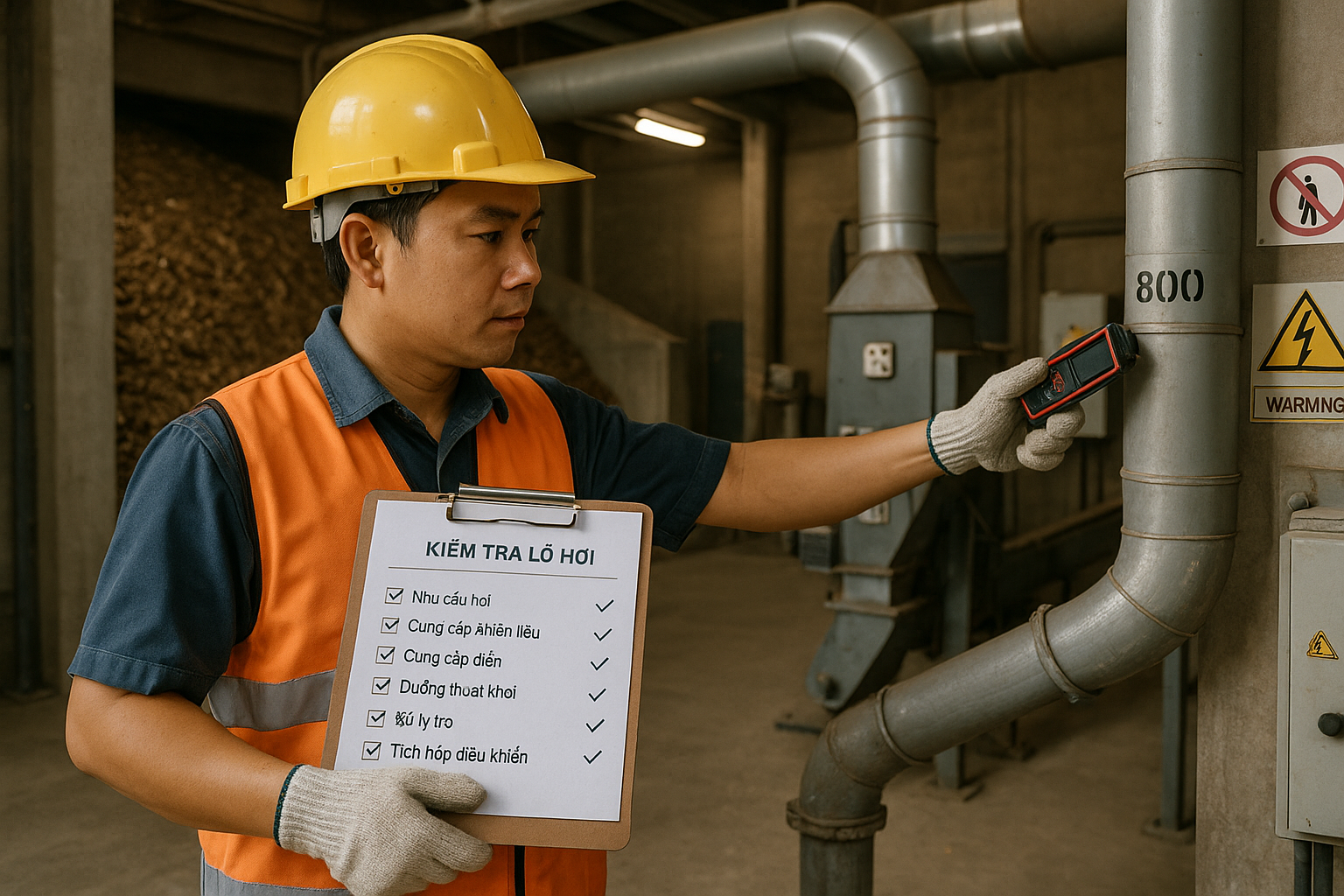
Simultaneously check steam demand, fuel characteristics and auxiliary infrastructure on-site before finalizing investment or refurbishment方案.
biomass boiler: key field assessment points
.. On-site, measure steam demand including daily required steam mass, operating pressure and steam quality (saturated or superheated). During maintenance or site survey measure peak and average loads to size the boiler appropriately. Also review locations for the steam drum, steam piping and air distribution grates.
Evaluate fuel sources by checking available types (sawdust, wood chips, pellets), moisture and particle size. Confirm stable supply near the plant and transport logistics… On-site, check minimum storage, the route from storage to feed hopper, conveyor systems and mass sensors to ensure continuous feeding.
biomass boiler: operational notes and implementation decisions
Survey site layout and infrastructure for power, stack, ash discharge and control; record clear checklist items:
- Footprint for boiler installation, fuel storage, maintenance access and safety distances.
- Existing power capacity and additional needs for fans, feed pumps, controllers and automation.
- Stack height, dust filter location and induced draft fan positioning to meet environmental standards.
- Ash disposal location, equipment for handling fly ash and bottom ash, and reuse or disposal plans.
- Ability to connect PLC/SCADA with existing systems and sensors for fuel measurement, water level and steam pressure.
- Feedwater quality, location for feed pumps and feedwater heater to optimize efficiency.
During surveying note operational risks: if fuel storage cannot ensure moisture control and stocking density, the project scope may need to expand to include drying or covered storage. If the stack and filter locations do not meet requirements, redesign the discharge route to comply with QCVN 19:2009/BTNMT. Check distance to residential areas and firefighting systems, along with explosion and fire protection measures for the combustion chamber as mandatory on-site requirements.
Preliminary conclusions at the site should be a technical checklist and risk items with recommended priorities (e.g., add fuel storage, upgrade power supply, or relocate the stack). Prepare a detailed survey report as the technical basis for design, costing and acceptance later.
8. Scope of work and factors affecting cost and schedule: biomass boiler
Enables cautious investment decisions by correctly viewing main variables such as boiler technology, automation level, emissions treatment, heat recovery, site condition and infrastructure refurbishment needs, instead of expecting a fixed number.
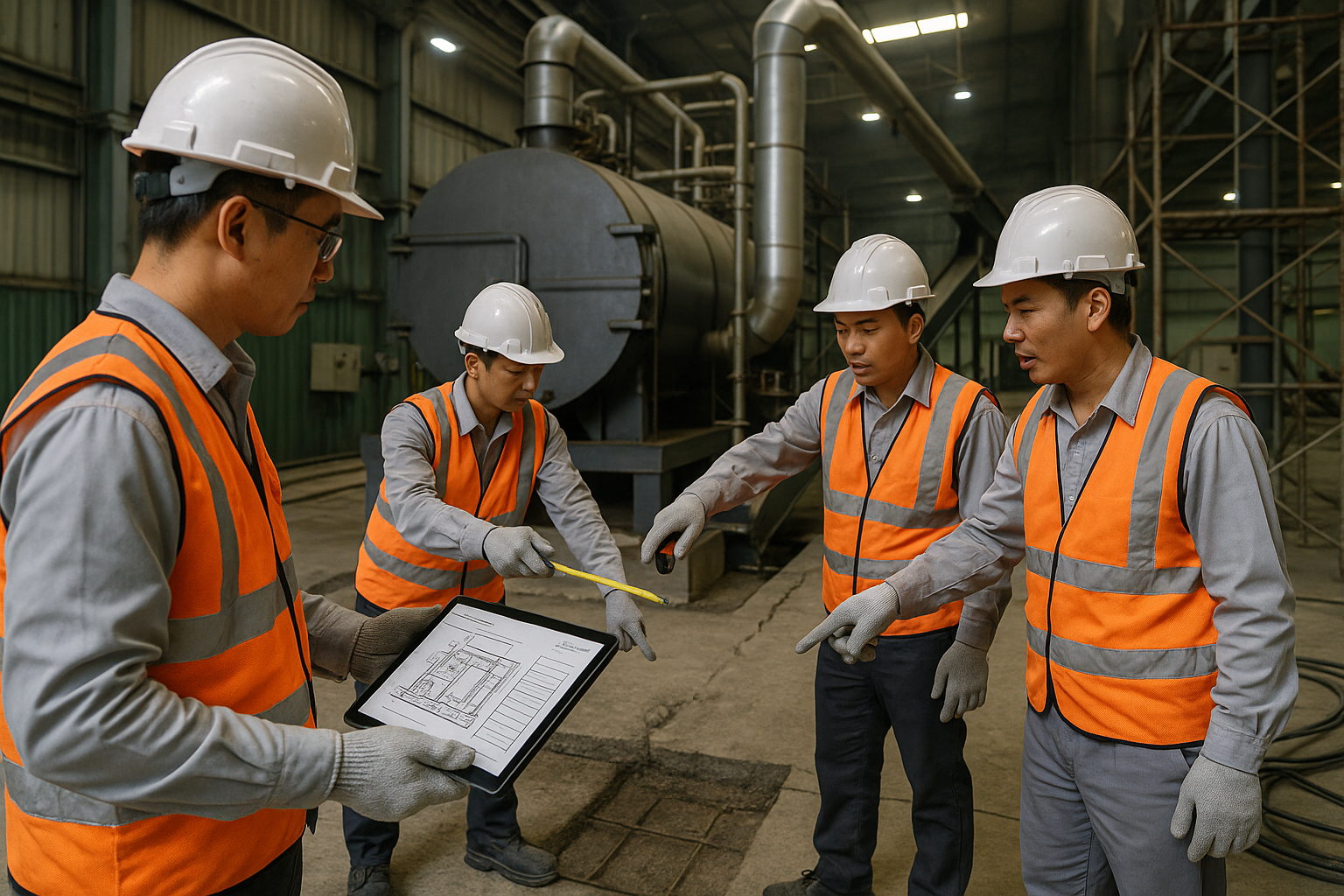
Cost and schedule for installing a biomass boiler depend directly on the scope of technical work and specific technology choices. Larger capacities and complex auxiliaries significantly increase design, construction and commissioning effort. In practice, decisions on fuel handling and environmental requirements often determine investment scale.
biomass boiler: key field assessment points
Typical scope of work includes the following mandatory subsystems, which must be clearly presented in tender documents and construction drawings:
- Fuel handling system: conveyors, screw feeders, hoppers and mass sensors.
- Combustion chamber and boiler body: fluidized bed or chain-grate design depending on technology.
- Fans, ash extraction and ash disposal systems.
- Emissions treatment: dust filters and measures to reduce SOx/NOx to meet standards.
- Feedwater heater (economizer), superheater and feedwater pump system with pressure-reducing valves.
- Automatic control system: PLC/SCADA, pressure, temperature and flow sensors.
biomass boiler: operational notes and implementation decisions
Technology choices are the main cost drivers. Furnace technology (fluidized bed or chain-grate) affects design cost, heat-resistant materials and combustion efficiency. Higher automation increases initial capex but typically reduces labor and downtime in operation. Emissions treatment required to meet QCVN 19:2009/BTNMT can increase total cost by about 20–30% depending on filtration and treatment requirements.
Regarding schedule, control integration and system tuning are often the longest steps. For a complete system, deployment typically takes about 3–6 months… On-site conditions determine foundation, piping and fuel storage retrofit work, and unsuitable infrastructure refurbishment can extend the schedule by 20–50%… In addition, fuel characteristics (moisture, particle size) often require shredding or auxiliary feeding equipment, increasing deployment time if complex.
Two decisive points before finalizing budget are emissions treatment scope and desired automation level. During commissioning and trial operation, missing auxiliaries like economizer or appropriate pumps will directly impact efficiency and operating cost. Operational warning: failing to complete emissions treatment per regulations can lead to fines and shutdown during acceptance.
To finalize price and schedule accurately, a site survey and the following minimum dataset are required:
- Desired capacity parameters (from 2.5 Tph and above if applicable) and load profile.
- Fuel characteristics: moisture, size, ash composition.
- Site condition: foundations, piping and storage space.
- Emission control requirements per regulation and desired automation level.
Conclusion. A preliminary estimate should separate cost components and present scenarios (basic/standard/high emission control). With full site data and fuel parameters, a detailed quotation and realistic schedule can be prepared to suit plant conditions.
9. Conclusion
When evaluating a biomass boiler for a plant, the right decision is not picking a single device but viewing the entire chain — fuel supply, combustion, steam generation, emissions treatment and control. A cautious approach is to survey fuel conditions, steam demand, site layout and environmental requirements first, then finalize the boiler configuration and appropriate auxiliary scope.
10. Frequently asked questions
Includes: fuel feeding system (hopper, screw conveyor/belt conveyor, valves), combustion chamber (chain grate or fluidized bed), boiler body and steam tube bundle (superheater/economizer), forced/draft fans, emissions treatment and ash handling, water pump and PLC/SCADA control system. During survey determine capacity, fuel type and environmental requirements.
Chain-grate is typically suitable for larger particle fuels, simpler operation and lower capital cost; fluidized bed (CFB) is flexible with diverse fuels, copes better with load swings and offers better emission control but is more complex. Choose based on particle size/moisture, load fluctuation and auxiliary investment capability.
It is recommended to include emissions treatment and ash handling from the start — they affect stack design, draft fan, site layout and cost. If data is lacking, design with higher processing capacity margin; required inputs: local emission limits, fuel composition and expected ash/slag quantities.
Decision depends on the current boiler condition, the gap to performance standards and fuel requirements. Rule: prefer refurbishment if frame and tube bundle are in good condition; replace when severe wear or configuration mismatch. Survey needed: metal condition, actual efficiency, emissions and estimated costs.
Heterogeneous fuel causes thermal fluctuations, unstable combustion, increased ash/slag and dust, and feeding blockages. Countermeasures: pre-processing (drying, chipping, screening), flexible feeding and control sensors. Collect data on size distribution, moisture and calorific value to select suitable handling systems.
Survey should include: steam demand by shift and its variation, type and quality of fuel, storage and feeding routes, installation footprint, power supply for fans/pumps, stack height, ash and emissions handling capability, environmental requirements and control integration. Gather actual data before design.
How to quickly evaluate a biomass boiler option before working with a technical vendor
- Determine the plant’s actual steam demand by operating mode and load variations.
- Review the expected biomass fuel type, supply stability and storage/feeding method.
- Check installation footprint, fuel feed route, ash disposal area and flue gas route.
- List all required auxiliary systems instead of only focusing on the boiler body and combustion chamber.
- Compare chain-grate and fluidized bed configurations by fuel characteristics and operational goals.
- Assess environmental, safety and control requirements before finalizing investment scope.
- Organize an on-site technical survey with the engineering team to clarify scope boundaries and implementation risks.
If the plant considers new investment or reviewing an existing biomass boiler system, start with a technical site survey to check fuel, steam demand, site layout and missing or unsynchronized auxiliaries.
Quang Anh đã nhận yêu cầu của Anh/Chị
Anh/Chị vui lòng kiểm tra email. Quang Anh đã gửi email xác nhận; nếu thông tin thuộc cấu hình tiêu chuẩn, báo giá sơ bộ sẽ được gửi qua email trong ít phút tới.
Sau khi xem báo giá sơ bộ, Anh/Chị có thể đề xuất lịch khảo sát để Quang Anh kiểm tra hiện trường và chốt phương án chính xác hơn.